
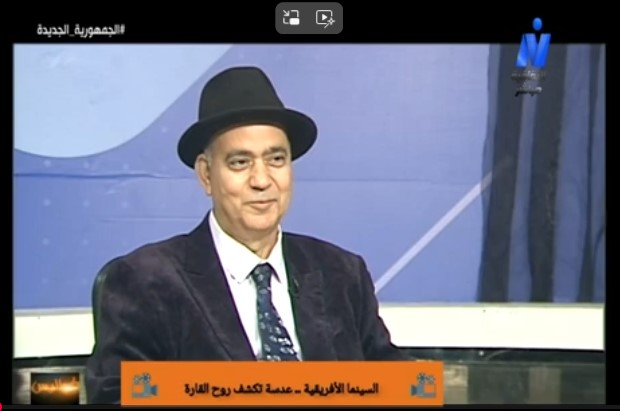
In an episode rich in intellectual and aesthetic significance, the television program “Kawalies” on Nile Cultural Channel hosted Dr. Ashraf Aboul-Yazid, Secretary-General of the Congress of African Journalists and Vice President of the Pan-African Writers’ Association for North Africa, to discuss African cinema as a screen of freedom, a tool for reclaiming narrative, and an open arena for the tension between identity and industry.
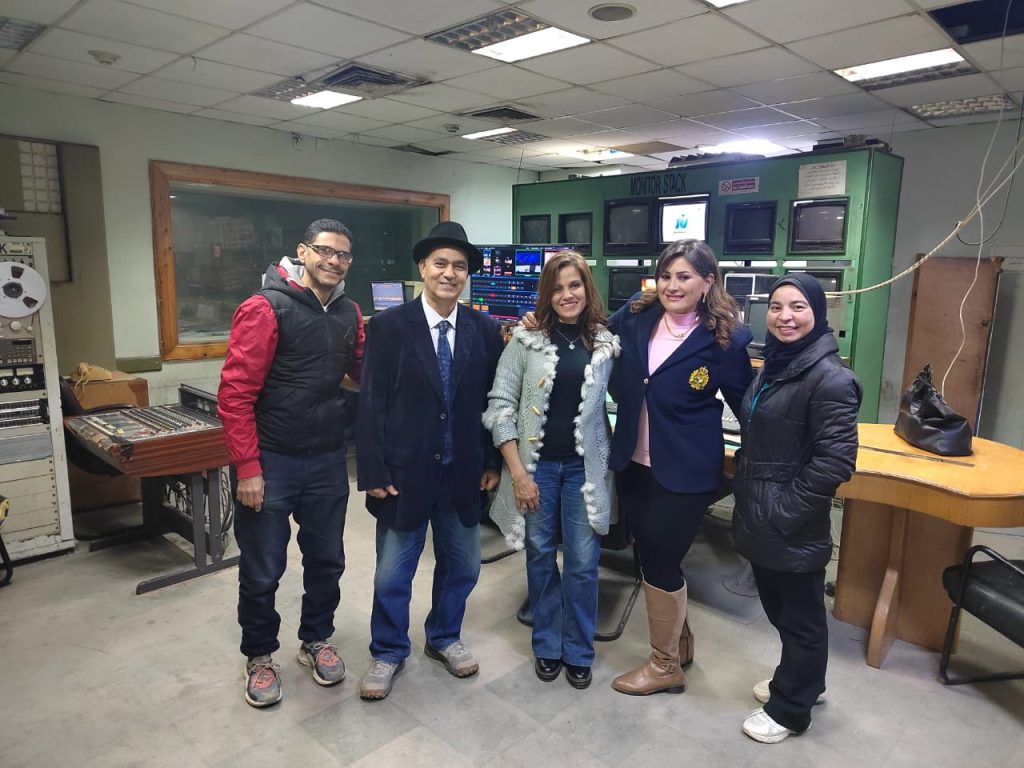
The Kawalies production team included television director Metwally Ismail El-Deeb, editor Hanan Fikry (research and preparation), director Suzanne Abbas El-Baroudy (coordination), executive director Ashraf Suleiman, production manager Heba Hassan, line producer Ibrahim El-Loul, with media presenter Nihad El-Haddini on screen. The episode aired at a highly significant moment, amid the growing presence of African films at major international festivals and the rise of digital platforms as a key player in reshaping exhibition and reception—reviving a central question:
Has African cinema succeeded in crossing from the margins of festivals to the heart of the global film industry, or is it still negotiating its right to narrative and circulation?
From Oral Storytelling to the Camera
At the opening of the episode, presenter Nihad El-Haddini set the conceptual framework for the discussion, noting that African cinema was born from oral storytelling and from a memory burdened by colonialism and deferred questions. Since the 1960s, the African camera has sought to reclaim voice, image, and identity through filmmakers who forged what may be described as a “cinema of resistance to absence.”
In this context, Dr. Aboul-Yazid stressed that African cinema has never been an artistic luxury, but rather a cultural and historical necessity, asserting that the camera in Africa has always been “an alternative eye to official history, a voice for the marginalized human being, and a memory confronting oblivion.” He added that the African creator is inherently multi-talented: the poet at festivals, for example, does not merely recite verse but performs it through dance, song, and rhythm like a theatrical actor—an approach similarly reflected in African cinema, rich with musical and sonic textures.
A Growing Presence at Global Festivals
The episode highlighted key African participations in major international film festivals between 2024 and 2026, demonstrating that African cinema is no longer absent from Cannes, Berlin, Venice, and the Oscars.
Notably, African cinema has achieved remarkable visibility at leading global festivals, signaling its transition from the margins to the center of the international cinematic scene. At the Cannes Film Festival, My Father’s Shadow by Akinola Davies Jr. marked a historic moment as the first Nigerian film selected for the Un Certain Regard section, reflecting Nollywood’s passage onto the global stage. Cannes also featured Aisha Can’t Fly Away by Morad Mostafa, which competed for the Caméra d’Or.
At the Berlinale, the Senegalese film Demba stood out after screening in the Encounters section and later representing Senegal in the Oscar race. In Venice, The Voice of Hind Rajab by Kaouther Ben Hania received wide acclaim for its powerful human and political charge. On the level of global awards, Dahomey by Mati Diop emerged as a model of African cinema that skillfully unites aesthetic expression with historical memory.
Digital Transformation: Opportunity or Threat?
In its second axis, the episode examined the impact of global streaming platforms on African cinema. Dr. Aboul-Yazid described these platforms as a double-edged sword: on one hand, they have created unprecedented opportunities for distribution and visibility, bringing African films to global audiences previously beyond reach; on the other, they sometimes impose production and narrative conditions that may threaten local identity and push toward a “homogenization of taste.” He emphasized that the real challenge lies not in technology itself, but in owning the narrative decision, affirming that “whoever owns the story owns the future—even in the age of platforms.”
Nollywood: From Phenomenon to Industry
The episode devoted significant attention to Nollywood more than three decades after its emergence. The guest argued that Nollywood is no longer merely a quantitative phenomenon, but has entered a phase of qualitative transformation in technical standards, script development, and the rise of a new generation of Nigerian women directors. He also addressed the issue of funding—between local financing and co-production—pointing out that financial independence remains essential for creative autonomy, even as international partnerships grow in importance.
The Novel on Screen
Another segment focused on the adaptation of African literary works into cinema, citing experiences such as those of Dr. Wale Okediran and others. Dr. Aboul-Yazid emphasized that African literature represents a rich narrative reservoir, yet translating it to film requires high cultural sensitivity so that texts do not lose their spirit to market demands.
Dr. Okediran’s experience stands as a significant model of creative interaction between literature and cinema in Nigeria. His works, rooted in social and political realities, are marked by strong dramatic structures and deeply drawn characters, making them well suited for cinematic adaptation. Transforming a novel into a film does not mean literal reproduction, but rather visual re-creation while preserving its core spirit and issues—thus opening literary texts to broader audiences, particularly younger generations.
Alongside Okediran, Nigeria has witnessed the adaptation of several major novels and stories into films, including works by Chimamanda Ngozi Adichie (Half of a Yellow Sun), Helon Habila, and other writers. These adaptations have reinforced cinema’s role as a cultural medium that re-presents literature in the language of the present, contributing to the documentation of collective memory, linking literary narrative to national concerns, and reaffirming literature as one of the most vital sources of contemporary Nigerian cinema.
Tenants of the House offers a bold cinematic treatment of a highly sensitive political and human conflict in Nigeria, embodied in the historical struggle between Fulani herders and Hausa farmers—a conflict that goes beyond land to touch identity and collective memory. The story centers on Samuel Bakura, a young member of parliament nearing the end of his first term, burdened by a deep personal wound after losing his father to this ethnic violence. This private pain becomes a moral and political catalyst, driving him to sponsor a parliamentary bill aimed at achieving lasting peace, in the face of entrenched interests, fear, and deep-rooted divisions.
During a field mission, a love relationship develops between Bakura and Batejo, a young Fulani woman, turning their bond into a harsh test of the possibility of reconciliation between the two communities. Bakura faces fierce rejection from his family and social circle, who view the relationship as a betrayal of past bloodshed. He is thus torn between political duty and familial belonging on one side, and human emotion on the other. The film succeeds in portraying Bakura’s gradual transformation from a young, limited-impact legislator into a national symbol of reconciliation, affirming that politics—when coupled with dialogue and empathy—can build bridges of understanding. At its core, the film reinforces a deep belief in cinema as an effective tool for promoting peaceful coexistence and restoring hope in divided societies.
In the episode, Dr. Ashraf Aboul-Yazid discussed the African cinema and theatrical literature’s ability to evoke myths and bring them to life, citing Nigerian playwright Esther Adelana’s “The Broken Pot” as an exemplary case of cultural convergence. He highlighted how the play illustrates the intersection of diverse traditions, blending certain Yoruba customs with Egyptian rural practices, reflecting the richness of popular storytelling. He emphasized the play’s exploration of belief in myth and its manifestation in reality: the daughter, whose right to marry the king’s heir was doubted, was not illegitimate as presumed but descended from princes. This demonstrates that myths are not mere fantasy but a cognitive and cultural framework capable of reinterpreting history and identity. Dr. Aboul-Yazid underscored that such theatrical and cinematic works offer African and global audiences alike an opportunity to grasp the depth of folk heritage and the power of symbols, showing that myths can serve as a bridge between past and present, local values and global thought, while also functioning as a tool for reflection on justice, identity, and belonging.
North Africa and the Horn of Africa: Cinema of Memory
The episode also discussed the state of cinema in North Africa and the Horn of Africa. In Egypt, Morocco, and Tunisia, cinema oscillates between festivals and the market, while in Ethiopia, Kenya, and Somalia a “cinema of memory and exile” has emerged—one that addresses identity, migration, and war as forms of soft resistance.
In a concluding segment before the final question, the guest emphasized the importance of African festivals such as Carthage, Luxor, Dakar, and Zanzibar, not only as screening platforms but as spaces for training and dialogue. He also pointed to the crisis of film criticism in both Arab and African contexts, and to the necessity of integrating cinema into cultural education as a tool of awareness and knowledge.
African Films on Nile Cultural Channel
The episode featured clips from several landmark films of contemporary African cinema:
Tsotsi (South Africa, 2005)
Tsotsi is a milestone in South African cinema, offering a profound human portrayal of post-apartheid violence. It tells the story of a young delinquent living in Johannesburg’s townships, drawn into crime as a means of survival, until an unexpected incident triggers inner transformation. Through a powerful visual language and sincere performances, the film avoids justifying violence, instead exposing its social and psychological roots. Its Academy Award for Best Foreign Language Film demonstrated African cinema’s ability to speak to the world in a shared human language without losing its specificity.
The Gravedigger’s Wife (Somalia, 2021)
This film represents a mature example of quiet, human-centered cinema, transforming a personal tragedy into a broader ethical and social question. It follows a modest man struggling against poverty and bureaucracy to save his ailing wife in a fragile society lacking health justice. Its strength lies in narrative restraint and attention to everyday details rather than melodrama. The camera stays close to the characters, and silence often speaks louder than dialogue. The film presents a different image of Somalia, far from stereotypical violence, affirming African cinema’s capacity to produce universal human discourse from the humblest stories.
Lionheart (Nigeria, 2018)
Lionheart offers a different model of Nollywood cinema, balancing entertainment with social commentary. It centers on a woman who takes over her family’s company in a male-dominated environment, opening discussion on gender, power, and labor. Its warmth, optimism, smooth narrative flow, and improved production values distinguish it. Its importance lies not only in being the first Nigerian Netflix Original, but also in breaking the stereotype of African cinema as solely crisis-driven, presenting a local story with global appeal.
Rafiki (Kenya, 2018)
Rafiki marks a turning point in Kenyan cinema for its bold treatment of love outside social taboo. More than a queer love story, it is a narrative about individual freedom against collective repression. The director employs vibrant colors and open spaces to highlight the contrast between harsh public space and intimate emotional worlds. Though banned locally, the film became a symbol of debate and dialogue, affirming cinema’s role as a tool of social questioning. Rafiki frames the right to love as a human right, giving African cinema a new, courageous voice.
Atlantics (Senegal, 2019)
Atlantics blends social realism with the supernatural to offer a poetic vision of migration and loss. The sea is not a backdrop but a symbolic character, carrying both death and hope. Through an unfinished love story, Mati Diop addresses unjust labor, forced migration, and the memory of the disappeared. The film’s calm rhythm and contemplative imagery give absence a powerful presence. Its historic achievement at Cannes reflects African cinema’s shift toward more experimental forms of expression. Atlantics is not merely an issue-driven film, but a sensory experience about the ghosts left behind by absent justice.
The Title of African Cinema in 2030
At the end of the episode, a symbolic question was raised:
If we were to write a title for African cinema in 2030, what would it be? And which film would you choose as a model of African cinema?
Dr. Ashraf Aboul-Yazid’s answer came like a cultural manifesto:
“African cinema is not a postponed future, but a present in the making—if it owns its tools, respects its stories, and bets on the human being.”
The “Kawalies” episode was not merely a television interview, but an in-depth reading of a cinema searching for its natural place in the world—not as an exotic margin, but as an authentic human voice that shapes its own image, on its own screen, through its own stories.