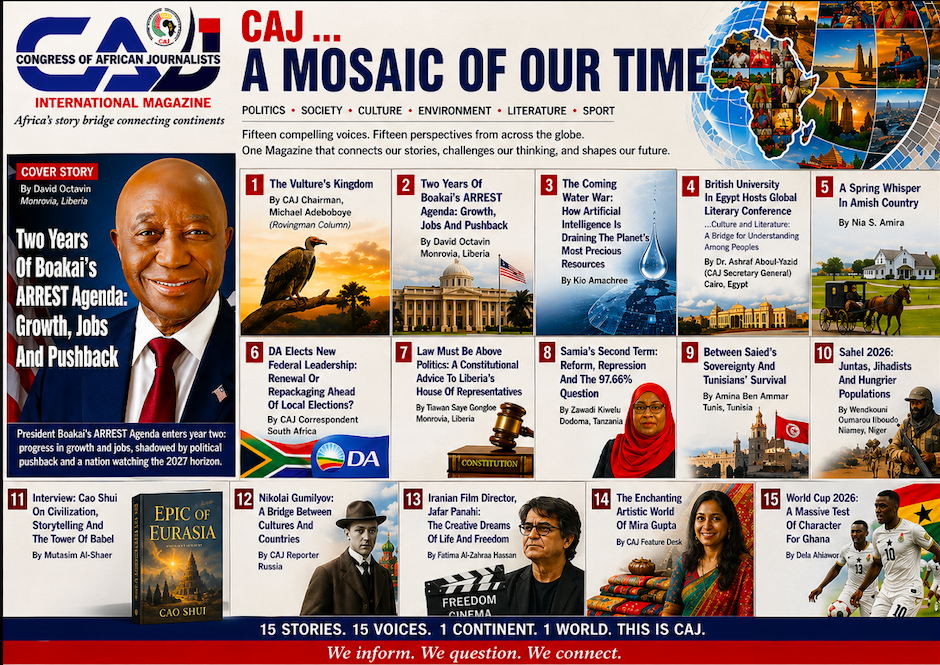
CAJ International Magazine … A Mosaic of Our Time

In this May 2026 edition, CAJ International Magazine brings together a powerful chorus of voices from across continents—each grappling with a world in transition, where personal grief, political tension, cultural dialogue, and global uncertainty intersect.

We open with a deeply human reflection in “The Vulture’s Kingdom” by CAJ Chairman, Michael Adeboboye, whose Rovingman column transforms private loss into a meditation on memory and survival. His elegy reminds us that behind every headline are lives navigating storms unseen.

From Liberia, David Octavin examines President Boakai’s second year in office in “Two Years of Boakai’s ARREST Agenda.” Growth figures suggest progress, yet political fractures and accusations of judicial overreach complicate the narrative. Tiawan Saye Gongloe reinforces this tension in his constitutional critique, warning that the rule of law must remain above political expediency.
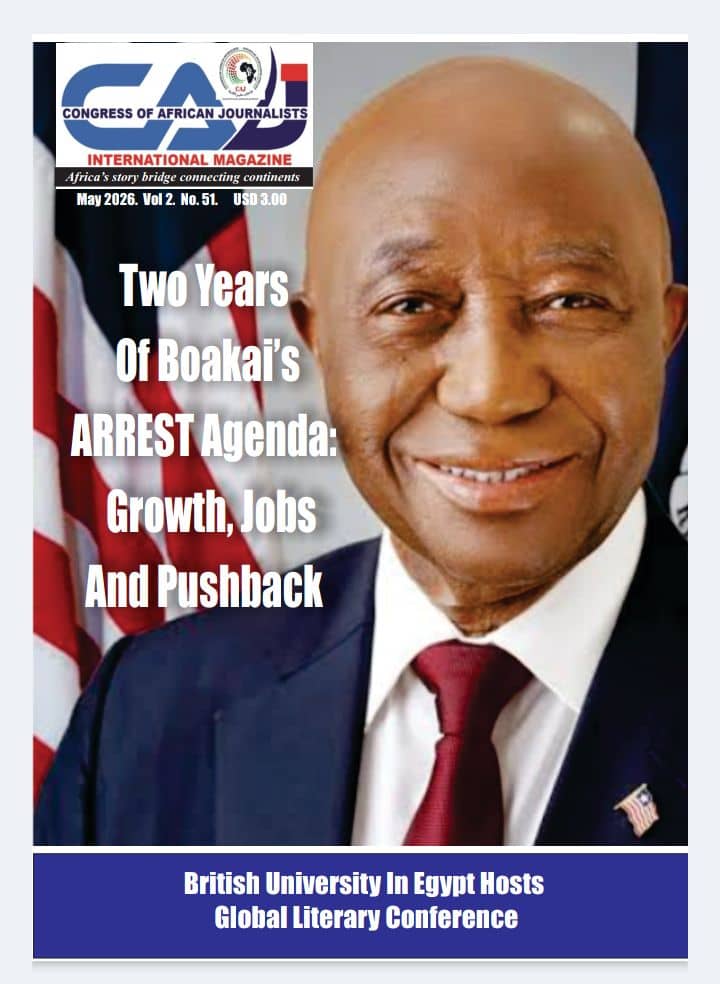
May 2026 edition, CAJ International Magazine

Across the continent, governance remains under scrutiny. Zawadi Kiwelu’s report from Tanzania interrogates the meaning of electoral legitimacy in the wake of President Samia Suluhu Hassan’s controversial re-election. Similarly, Amina Ben Ammar writes from Tunisia on the widening gap between state rhetoric and citizens’ lived realities, where economic figures fail to translate into daily relief.

Regional instability looms large in Wendkouni Oumarou IIboudo’s stark analysis of the Sahel, where insecurity, displacement, and food crises converge. His report underscores a troubling truth: the retreat from democratic processes often deepens, rather than resolves, instability.

Beyond politics, this issue explores emerging global dilemmas. Kio Amachree’s “The Coming Water War” exposes the hidden environmental cost of artificial intelligence, revealing how technological advancement may be quietly depleting one of humanity’s most vital resources—freshwater.

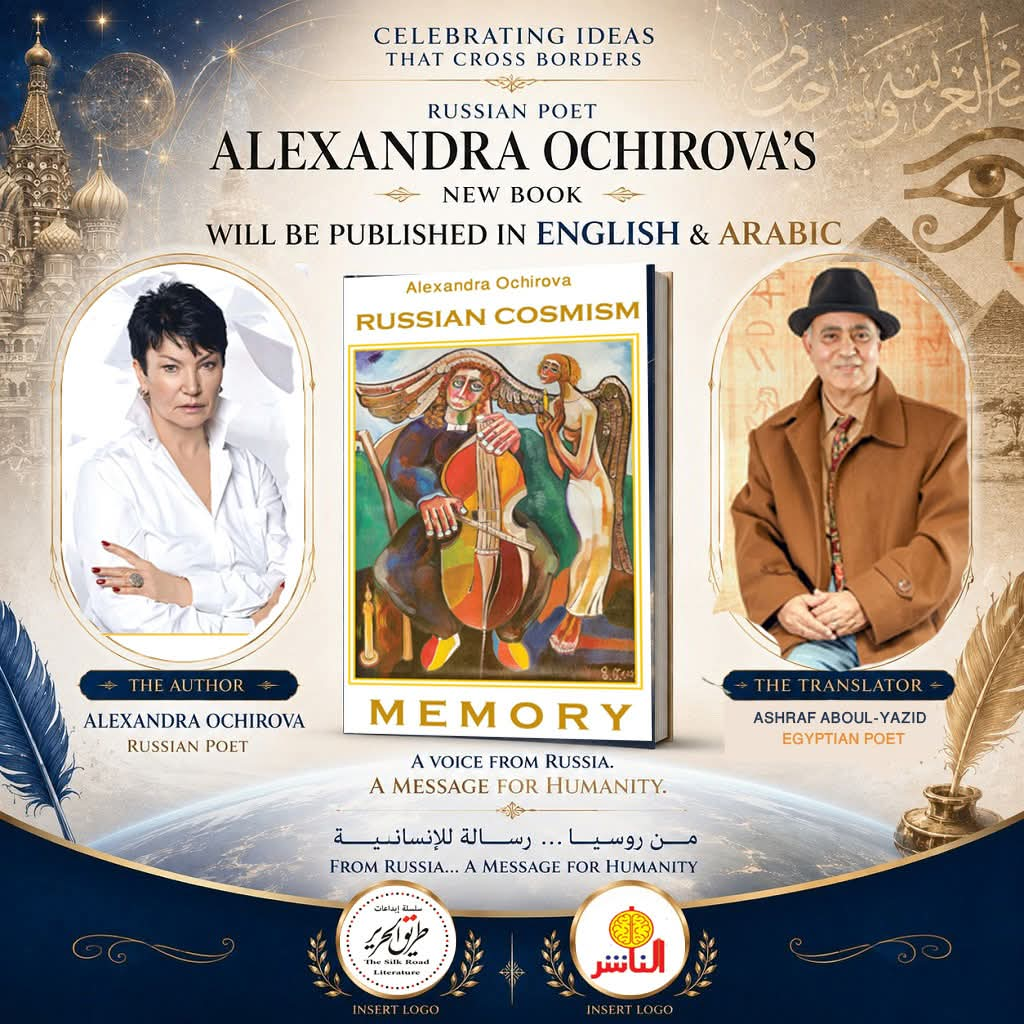
Yet, amid these challenges, culture persists as a bridge. Dr. Ashraf Aboul-Yazid, CAJ Secretary General,  reports on a major literary gathering in Egypt, hosted by the British University in Egypt, affirming the enduring role of dialogue in fostering mutual understanding. This theme resonates in our coverage of the Nikolai Gumilyov cultural evening in Russia, where literature becomes a meeting point for nations.

Our literary spotlight continues with Mutasim Al-Shaer’s interview with Chinese writer Cao Shui, whose expansive vision seeks to unify civilizations through storytelling. Likewise, Fatima Al-Zahraa Hassan profiles Iranian filmmaker Jafar Panahi, whose return to Tehran embodies the enduring tension between artistic freedom and political constraint.

In a quieter register, Nia S. Amira’s journey through Amish country offers a contemplative contrast—a world that resists modernity, inviting reflection on alternative ways of living. Meanwhile, our feature on Mira Gupta celebrates the preservation of heritage through design, demonstrating how tradition and innovation can coexist creatively.

Political change is also unfolding in South Africa, where the Democratic Alliance’s leadership transition raises questions about renewal and representation ahead of crucial local elections.

Finally, sport reminds us of resilience and identity. Dela Ahiawor’s analysis of Ghana’s national team ahead of the 2026 World Cup captures a nation at a crossroads, where instability off the pitch threatens performance on it.

Together, these 15 contributions form more than a collection of articles—they create a mosaic of our time. They challenge us to look beyond numbers, beyond narratives, and toward a deeper understanding of the forces shaping our world.

At CAJ, we remain committed to amplifying voices that inform, question, and connect.

Related Posts

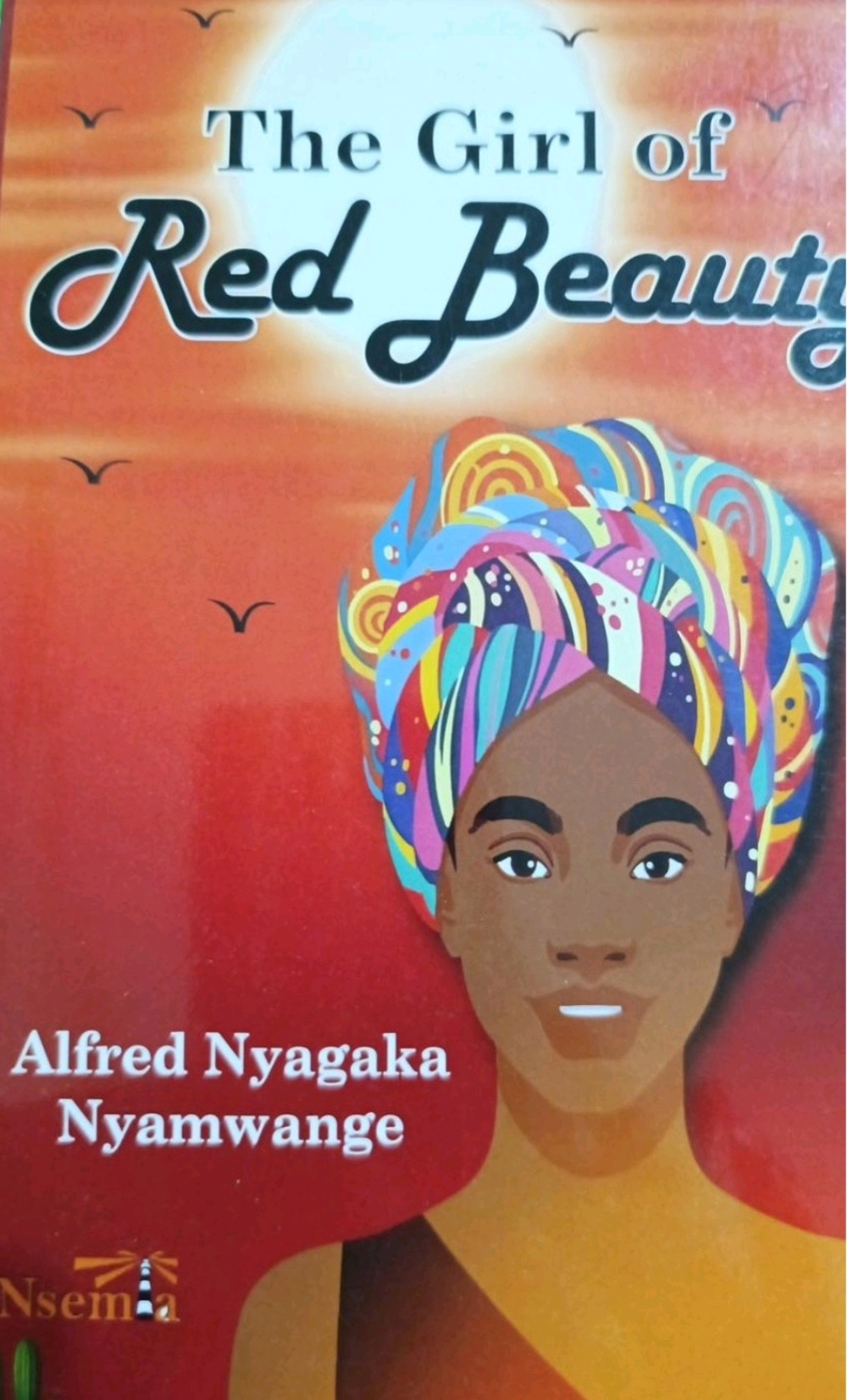
A Look at Alfred Nyagaka Nyamwange’s Collection of Books

  THE GIRL OF RED BEAUTY  What does it mean to belong to a people, and how can a community preserve its identity when the voices of its ancestors begin to fade beneath the pressures of modernity? In The Girl of Red Beauty, Alfred Nyagaka Nyamwange invites readers into the cultural universe of the AbaGusii through a sustained poetic engagement with the community’s oral traditions, beliefs, social practices and philosophies. Presented in thirteen chapters of verse, the work draws upon songs, proverbs, sayings, stories, play games and the rhythms of everyday life in the Gusii highlands. Its poetic world follows the human journey from birth and childhood through initiation and marriage to old age and death. Along the way, it evokes relationships between individuals, families, the land, the ancestors and the divine. The girl at the centre of the work becomes a poetic point of entry into a much wider cultural landscape: a world shaped by communal memory, inherited wisdom, social expectations and changing relationships. The collection is distinctive in its creative negotiation between written poetry and African orature. Its language draws on indigenous expressions and direct translations from EkeGusii, bringing local imagery and proverbial thought into English. Songs, performance rhythms and the imagined presence of the lyre and drum give the written verse an oral energy, inviting readers not merely to observe the culture but to hear, sing and imaginatively participate in it. The Girl of Red Beauty is both a literary work and an act of cultural remembrance. It does not present tradition as a museum piece; rather, it opens a space for considering cultural continuity, the tensions between inherited practices and contemporary life, and the responsibility of transmitting indigenous knowledge to future generations. Rooted in Gusii experience yet attentive to wider questions of identity and belonging, the book offers international readers an encounter with the imaginative resources of an African community. A poetic celebration of identity, a preservation of memory and an invitation to return to the living sources of cultural knowledge. THE FOOTFALLS OF MY HEART  Love may begin with attraction, but in a traditional community its consequences reach far beyond two individuals. In The Footfalls of My Heart, Alfred Nyagaka Nyamwange presents a narrative poem that explores courtship and marriage in the cultural world of the AbaGusii, giving particular prominence to the voice, perspective and agency of the bride. The poem centres on Gechemba and Rimura. Rimura is a celebrated warrior and prospective groom whose reputation, strength and determination do not automatically guarantee success in love. Gechemba is a young woman who observes, questions, teases and responds to the man seeking her affection. Through her perspective, the reader encounters the emotional play of attraction, hesitation, playful resistance and growing attachment. The courtship becomes a spirited exchange in which wit and persuasion matter alongside status and material wealth. Beyond the romantic encounter, the work traces the social processes through which marriage connects families and lineages. It evokes the meeting between prospective partners, family introductions, negotiations over bride wealth, preparations, marriage rituals, songs, communal celebrations and the incorporation of the bride into a new household. Cattle and other forms of bride wealth carry meanings that extend beyond payment: they express commitment and create networks of relationships between families. The poem is rich in EkeGusii expressions, proverbs, indigenous imagery, humour and the rhythms of oral performance. It draws on cultural memory while allowing readers to consider the values and tensions embedded in marriage practices. The bride’s voice is especially important: she is not simply an object of pursuit but a participant whose response, judgement and choice shape the unfolding relationship. As a companion to The Girl of Red Beauty, this work extends Nyamwange’s poetic exploration of Gusii cultural life. Where the earlier poem approaches the community through a girl’s growth and the wider cycle of life, The Footfalls of My Heart foregrounds the woman’s perspective in the journey towards marriage and family continuity. A warrior pursues; a woman responds and chooses; families negotiate; a community gathers. The Footfalls of My Heart is a poetic exploration of love as both an intimate emotion and a communal bond. THE BROKEN COLUMN  What happens when a society’s established ways of life encounter forces that challenge its institutions, beliefs and sense of identity? The Broken Column by Alfred Nyagaka Nyamwange is a historical and cultural novel set in the world of the AbaGusii, tracing the experiences of a warrior and the wider transformations of his community. At the centre of the narrative is Okeyo, a young man renowned for courage, physical strength and exceptional skill. His reputation as a warrior places him within a social order that values protection, honour, responsibility and service to the community. Yet Okeyo’s life is not a simple succession of heroic achievements. His relationships, personal struggles, choices and encounters with adversity expose the vulnerabilities beneath the public image of the fearless warrior. His destiny is shaped by the demands of his calling and by the changing circumstances of the society around him. The novel evokes a community organised through kinship, village life, ancestral expectations, warrior traditions and collective obligations. Its landscape is not merely a backdrop: it is a lived environment in which cattle, homesteads, social relations and communal security carry cultural significance. Okeyo’s experiences intersect with those of other people, particularly the women whose presence and decisions influence his path. A profound historical change gathers around this personal story. The arrival of foreign authority, missionary Christianity and colonial power unsettles the foundations of the community. Established loyalties are questioned; inherited practices encounter new religious and political claims; and individuals must negotiate the competing demands of continuity, resistance and accommodation. The meaning of courage itself becomes uncertain as the society confronts a future it cannot fully control. The Broken Column therefore operates on two connected levels: it is the story of a man whose life contains both achievement and vulnerability, and the story of a people experiencing a difficult historical transition. Through its engagement with masculinity, identity, power, faith, tradition and colonial encounter, the novel invites readers to consider what happens when the structures that sustain a community begin to fracture.…

Dance in Silence, Poem by Anwar Rahim

They speak without a sound Their steps upon the ground No music needs to play Their hearts still find the way Two shadows in the light They hold each other…

اترك تعليقاً

لن يتم نشر عنوان بريدك الإلكتروني. الحقول الإلزامية مشار إليها بـ *