 thesilkroadtoday
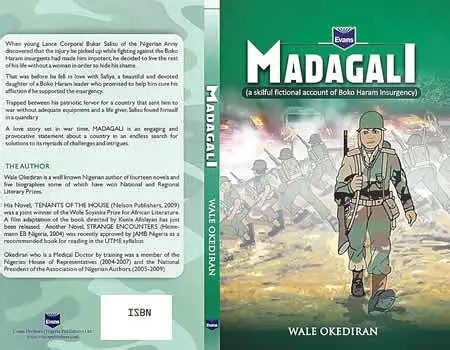
A review of Wale Okediran’s MADAGALI by Ifeanyichukwu Peter Eze
MADAGALI is a story of love in the time of war.
Bukar, a young lance corporal of the Nigerian army, born of a Nigerian father and Liberian mother, is injured in a deadly ambush by Boko Haram.
At the hospital, it is discovered that the injury has rendered him impotent. But his desire to keep that to himself and stay away from women is not helped by the web of love that confronts him. This pushes him to seek remedy in between repelling the insurgency and staying in love. He is attracted to Safiya, a humanitarian worker and daughter of a former Boko Haram leader. She helps him secure an herbal remedy from a mallam but blackmails him with a demand for information: to ambush the food going to biu and pass the food to the starving Boko Haram boys. Else, she would go back to the mallam and revoke the healing. For Bukar, this is a moral decision steeped on his freedom from his erectile dysfunction and the love for his country.
The Boko Haram movement has been in Nigeria since 2009. The name translates to ‘western education is forbidden.’ It has killed thousands of people. But who is the real enemy? Why is the war still lingering after more than 10 years?
Told from the eyes of Bukar, the protagonist, the tone is personal and introspective. As a witness’ eyes, it initiates and ensures an engaging, sincere, and unapologetic exploration of the Boko Haram menace, and as well, confirms the truth hidden in whispers and rumours rather than what we get from official documents. It lays bare the double standards of the Nigeria armed forces, the labyrinths of underhand collaborations between the people in high places, the NGOs, and insurgents.
Colonel Yusuf Abu is killed by the military top guns in what is documented as an ambush by the enemy, because of his huge potential to end the war. In that same vein, Bukar is wrongly accused, tortured and imprisoned for possessing bomb- making materials in a package he is to deliver for Lieutenant Colonel Humus, and whose contents he does not know anything about. While some aid workers are middlemen for some arm dealers.
Interestingly, the narrative alternates between Nigeria and Liberia where Bukar’s family has arranged a wife for him.
Liberia offers a contrasting fortune of peace and calm to the artilleries, bombs, rockets, and death that have become Nigeria’s image. Peace, it seems, is an almost impossible achievement.
The story flows simply in an unadorned, sometimes raw, but effective language. Most of its strength wears a journalistic verve to give credence to the investigative run of the text with a sense of elaborate history. As a result, the dialogue is a huge informant.
The writer’s wealth of travel experiences shines on the pages. He takes us through the terrain of the lingering war: from Madagali to Baga, Katarko to Kano, Kaya to Gulag, Maiduguri to Ngala, military camps, IDP camps, war strategies, hungry civilians, lost children, dishevelled women, repentant insurgents, and their likes.
There is an undertone though. And this, I feel is a subtle questioning of the hypocrisy in the system. How do you fight a war you help sustain knowingly? The existence of sympathisers of Boko Haram in both the military and the NGOs undermines the efforts and the moral choices of individuals who are genuinely fighting to end the scourge. Wouldn’t Bukar have laid his options differently than put the lives of his colleagues at the mercy of a deadly ambush? Safiya provides a watershed link to the passage of information between both sides: the military and the insurgents. It suggests, and validly so, that the hands of the humanitarian services are deep in the dirty waters of the matter.
There is the case of the so called repentant former Boko Haram members who still pander whose policies offer better economic well-being and security between the Nigerian government on one hand, and the terrorists on the other. If the government is not forthcoming, they turn their allegiance back to the terrorists. This is the case of Safiya’s father who has gone back to the group. He had initially joined the group to raise money to send his daughter to school.
Remarkably, the voice behind the novel is urgent; a huge eye opener to the decay in the Nigerian military. The NGO’s in charge of the IDP camps are not left out in the lash that this book is. Ultimately the drive here is to create the right consciousness in the face of deceit. This book holds the light.
Eze is a literary enthusiast
Previously published in Tribune Online, Arts and Reviews