 thesilkroadtoday

By Amine Martah
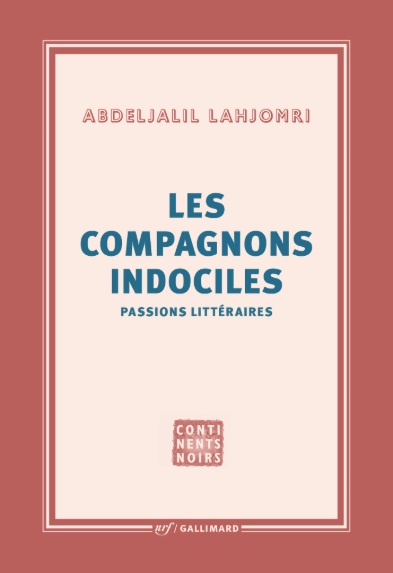
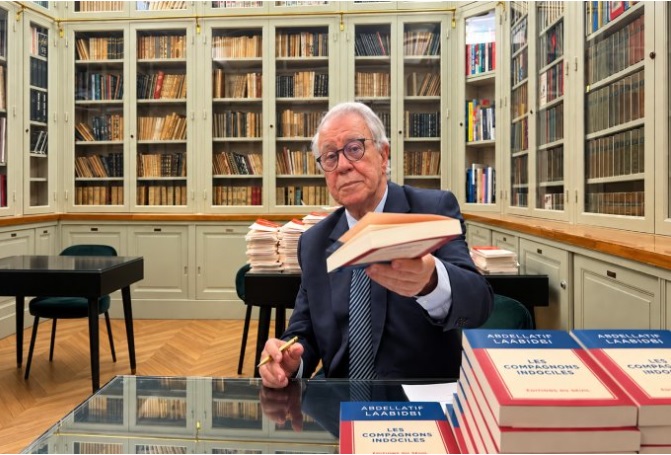
Abdeljalil Lahjomri’s Les Compagnons indociles (The Rebellious Companions), published by Gallimard, celebrates literature while challenging the habits and certainties of the literary world. In the hands of Amine Martah, a professor at Cadi Ayyad University in Marrakech, the book emerges as an invitation to rediscover the pleasure of reading, the rigour of writing, and the freedom of debate.
Moving between reflections on language, critical perspectives on Moroccan literature, and tributes to writers, the book offers a passionate journey through the world of books—one in which admiration leaves ample room for disagreement and controversy.
Abdeljalil Lahjomri, Permanent Secretary of the Royal Academy of Morocco, has published with Gallimard, in its “Continents Noirs” collection, a book of encounters, a book that is also a library in itself. He has given it the title Les Compagnons indociles, devoting it entirely to a passion for literature—a fundamental and inalienable identity, affirmed unmistakably by its subtitle: Passions littéraires (Literary Passions).
This is one of those books that make you want to meet the author, to sit with him over a cup of coffee or a glass of mint tea and talk. The author becomes an object of intellectual affinity, someone with whom one longs to exchange ideas, someone who inspires hope in the possibility of dialogue—a dialogue potentially rich in meaning.
The author is rescued from a deathly sanctity and brought back to life from the theoretical tomb—much to the displeasure of Roland Barthes—so that he may once again occupy a chair, breathe, and even walk alongside the reader. He is no longer that distant, authoritative figure, forever cold, even when his scientific and intellectual eminence is acknowledged and admired.
These are books of encounter: vibrant, life-giving books that restore to writing its conversational dimension and awaken it to what it was from the beginning and remains to the end: a benevolent exchange around shared subjects and common passions. This book is certainly one of them, but it is also something more.
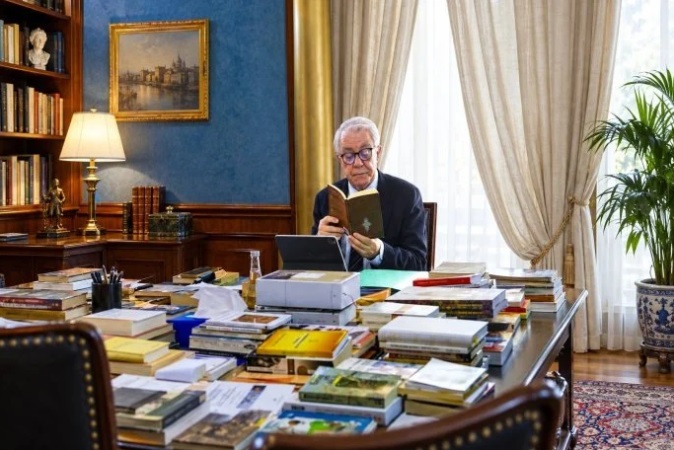
It is also the kind of book that makes one dream about the author’s library. If the reader were to have coffee with him, they would hope to do so among his books, in the scholarly intimacy from which knowledge emerges and is made available through the ingenious composition of this book-as-library. This is not merely a matter of listing titles, displaying them, and providing references.
Rather, it is the feeling of a powerful presence: that of a seasoned reader who inhabits—or even haunts—his library, in the sense that every book he has read becomes his own, becoming part of his thinking. A book-as-library is not a compilation of names, still less a demonstration of erudition. It is the very act of reading made tangible, transformed into a “movement that shifts the lines,” into paragraphs and pages.
To be admitted into such an author’s library is to feel the desire to read—and to learn how to read. This book is an education, perhaps even a relearning of the art of reading.
Since Spinoza, we have distinguished sad passions from joyful passions. Some passions are contagious; others, more importantly, become banners under which people rally. As a standard-bearer of such passion, the author invites us to march through these pages towards a modern battlefield: the reconquest of the territories literature has lost.
We must not misunderstand this mission. This is no jumble of slogans shouted loudly only to return as repetitive echoes. It is a passion that persuades, guiding the reader’s eyes and mind through arguments and, above all, through a demonstration embodied in both form and substance.
The first thing that surprises and impresses us is the language and style.
Throughout our shared and tumultuous history with the French language, some have succumbed to its tyranny without uttering a word; others have waged war against it and regarded it as “spoils”; still others have sought to graft their mother tongues onto it, pushing this process towards creolisation and even beyond. This book calls for balance and precision: complete mastery that brings confidence in usage and effectiveness in expression.
Herein lies the completeness and effectiveness of its argument. The style submits itself to a duty of restraint and purity, and every sentence offers tangible proof of this commitment. It is an exacting standard that the author applies to himself before demanding it of others.
For readers who may not be sufficiently equipped to perceive the painstaking work carried out throughout the book, the afterword makes the author’s intention explicit: “Writing, like reading, requires an art of balance: knowing how to remove more often than to add, to prune rather than accumulate.”
When the author adds in the following line, “I confess to a constant attachment to the expansive, Mediterranean sentence…”, we begin to appreciate the austere labour involved, the poetic art put to the test in the text. Boileau is, of course, cited in the book.
It is therefore natural and legitimate that the author should denounce, for example, what he calls a “counter-poetics of language”, which he identifies in the work of certain highly publicised names in Moroccan literature, with Abdellah Taïa as its unfortunate “standard-bearer.” Along the same lines, we encounter an open question concerning “the family language,” a concept the author borrows from Abdelfattah Kilito to highlight its significance and extend the debate surrounding it.
If, as the celebrated essay by Abdelfattah Kilito suggests, “we speak all languages, but in Arabic,” the traces of one’s mother tongue remain persistent, perhaps even indelible. The author seems to invite us to reflect on their systematic use, if not their easy and effortless deployment. Might this not reveal an abandonment of the demands of writing, a loosening of the search for the precise word and the exact expression? The text leaves this question unanswered.
Nevertheless, the author’s language itself provides a kind of affirmative response. The imperative of refinement is so strong that it becomes demonstrative, even exemplary. Yet, steeped in a culture of debate, the book wisely refrains from delivering a final verdict on such a vast and complex issue. As Flaubert might have said, foolishness lies in the desire to conclude.
More importantly, the author’s thinking tends towards dialectical transcendence, as he proposes approaching the question from the opposite angle: speaking French—or other languages—in Arabic, or finding oneself speaking Arabic in French.
As a noble horizon for this debate, he declares:
“These fruitful exchanges between languages cannot be reduced to mere lexical contamination or a mechanism for economising thought. They express a deeper movement involving the intermingling of imaginaries, syntactic rhythms, and mental structures.”
This bold breach in the wall of critical conventional wisdom—which seems to dominate the literary milieu, or, to be more precise, the absence of genuine literary debate—is not the only one. The book opens many other such breaches.
As a final example, without saying too much, we may mention the author’s equally forthright position in favour of the “abolition” of the “I.”
Here again, rigour is paramount, and the temptation of taking the easy route is rejected. Instead, the author sincerely calls for honest effort and a sense of responsibility. In his essay Literature in Peril, Tzvetan Todorov had denounced a “solipsistic” form of literature as one of the modern dangers threatening the literary enterprise.
The author of this book identifies manifestations of this tendency in Moroccan literature, perhaps reinforced—or even legitimised—by a certain biographical tradition that accompanied the very emergence of that literature. “The memories of one person after another are certainly moving, but they all resemble one another,” he declares bluntly.
This is enough to make an urgent literary debate necessary, while also encouraging profound self-examination. At least, that is the author’s earnest hope—and ours.
Many other taboo subjects, imprisoned by personal quarrels, whispered conversations, and restricted exchanges, are brought out of their incomprehensible confinement: whether colonial literature exists as a distinct category; anti-literature and its media impact; and the modern mechanisms through which literary reputations are established, among other questions. To the discerning reader, a greeting!
The book also rescues from oblivion certain neglected, sacrificed, or even massacred figures of literature in general, and Moroccan literature in particular. For this is also a book of tributes: first, to the universal literary heritage; then to a particular literature, namely Moroccan literature written in French; and finally to those whom the author calls “these rebellious companions.”
Yet, as the title makes clear to those who know how to read it, these are not insipid, pompous tributes that ring hollow like commonplace personal opinions. They are genuine acts of homage—tributes that do justice through precision and fairness.
For Lahjomri, paying tribute allows, and may even require, the expression of disagreement and difference. Thus, within this select circle of writers, Mr Lahjomri offers several authentic tributes without turning their recipients into untouchable icons.
As he concludes in the afterword, he makes them his “companions,” including “those whose works have provoked debate, reservations, or disagreement.”
Some readers might ask: what is the genre of this book? Would it not have been wiser to specify that from the outset? Certainly. Yet demonstrating a genre is better than simply declaring it. The cover remains silent on the matter, while the author’s introduction suggests that the pieces are chronicles.
Nevertheless, we must say, borrowing René Magritte’s famous formulation, “This is not a pipe”: this is not a collection of chronicles.
The brief and necessarily incomplete account we have offered may prepare the reader for an essay, for the book possesses the substance, composition, and rigour of one.
At the end of this journey, the book remains an immense landscape of reading, at once a collection of tributes, a book of encounters, and a library in its own right. Ultimately, this should come as no surprise.
The work opens with a quotation from Jorge Luis Borges:
“Let others boast of the pages they have written; I am proud of the pages I have read.”
The quotation summons the reader into the universal library. At the other end of the book, Roland Barthes is invoked once more:
“To write reading is to make audible what reading has made of the text.”
This final reference calls for the co-construction of meaning through a personal, free, and consciously embraced act of reading.
In the end, what remains most persistently in the mind is the image of the author’s library: a promise, and an inexhaustible source of books yet to come.
References and Notes
- Charles Baudelaire, “Beauty.”
- Page 211.
- These verses seem to be repeatedly invoked: “Twenty times return your work to the loom; / Polish it ceaselessly, polish it again; / Sometimes add, and often erase.” (Boileau)
- Page 69.
- Page 41.
- Page 71.
- Quoted on page 71.
- Page 74.
- Page 40.
- Tzvetan Todorov, Literature in Peril, Flammarion, 2007, 94 pages.
- Page 40.
- Page 211.
- The book’s epigraph.
- Page 212.