 thesilkroadtoday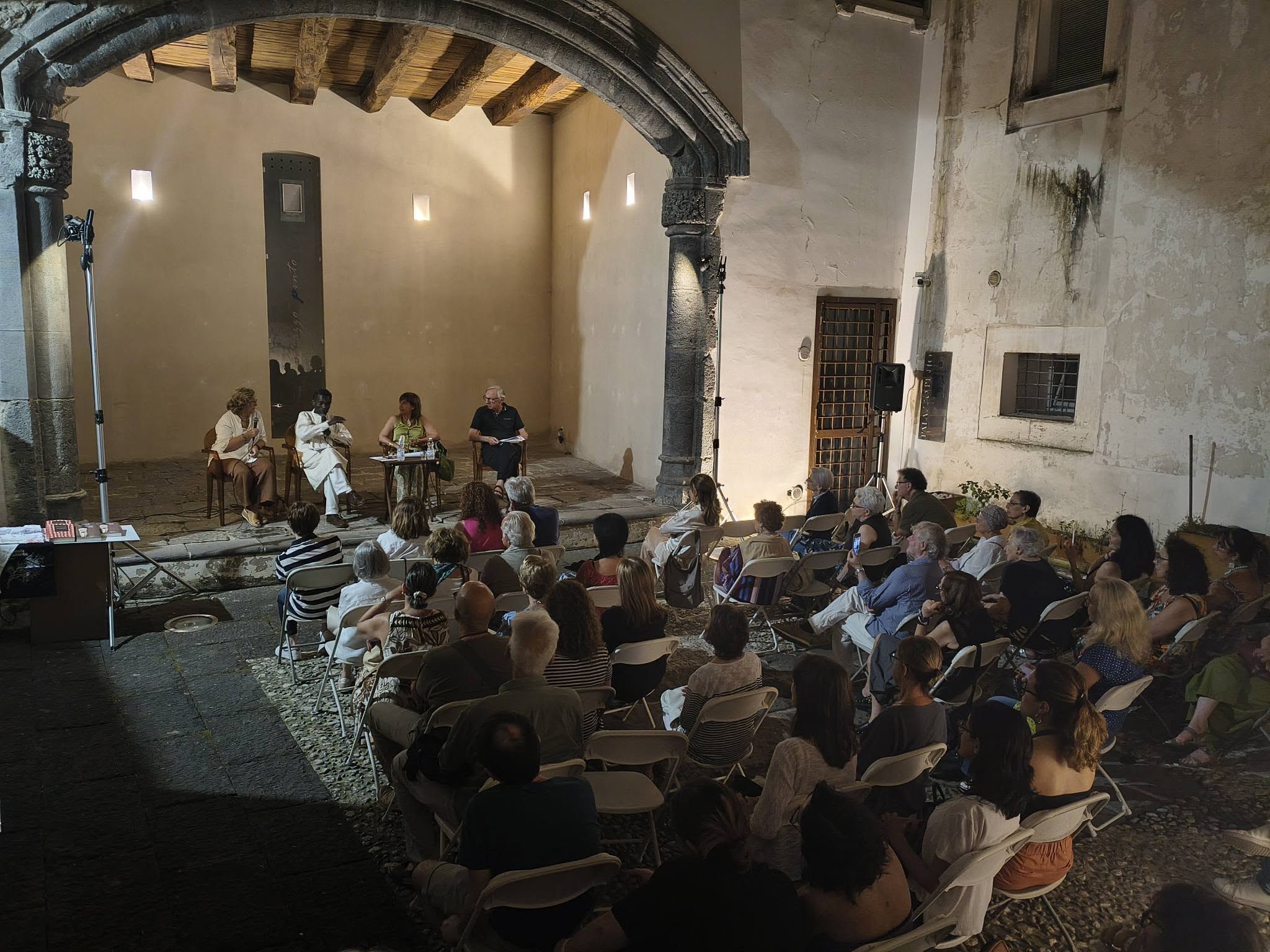
Salerno, Italy – An evening of rare cultural intensity unfolded at the historic Arco Catalano as renowned Malian scholar, poet, and manuscript guardian Ismaël Diadié Haïdara captivated audiences with an encounter where history and poetry converged in extraordinary harmony.

Organized by Casa della Poesia, the event transformed the evocative medieval setting into a living space of memory and dialogue. The atmosphere of the Arco Catalano served as a fitting backdrop for Haïdara, the last descendant of the family entrusted for centuries with safeguarding the legendary Fondo Kati of Timbuktu—one of Africa’s most important collections of ancient manuscripts.
The evening opened with the reflective thought: “Open the door when love arrives. Open it again with gratitude when it departs.” This sentiment perfectly captured the spirit of the gathering, which celebrated not only poetry but also the enduring power of human encounters and cultural exchange.

There was something profoundly poetic—and almost miraculous—in witnessing Ismaël Diadié Haïdara, heir to a lineage that protected thousands of manuscripts from destruction, war, and the advancing desert, reading his poems and sharing his reflections only a few steps away from the audience. His literary references ranged across civilizations and centuries, invoking figures such as Horace, Virgil, Giacomo Leopardi, and Philodemus of Gadara, thereby placing the heritage of Timbuktu within a broader, universal conversation on literature and knowledge.

The evening highlighted a compelling idea: culture as both a bridge and a lifeline. Haïdara brought with him not only his poetry but also the memory of a learned, tolerant, and universal Africa. His presence reminded the audience that books and words are not static objects confined to shelves; they are living entities that travel, endure, and connect distant shores of the Mediterranean and the wider world.
At a time marked by rapid transitions and digital distractions, the Arco Catalano became a resonant chamber for the quiet labor of memory and the enduring force of the written word. For a few unforgettable hours, Salerno seemed to reclaim its historical identity as a vibrant crossroads of cultures and knowledge, recalling the spirit of the medieval city that once welcomed scholars and ideas from across the Mediterranean.


The encounter with Ismaël Diadié Haïdara reaffirmed the essential role of literature and cultural heritage in fostering dialogue among peoples and preserving humanity’s collective memory. It also stood as a powerful tribute to the resilience of manuscripts, poetry, and the human spirit that continues to protect and transmit wisdom across generations and borders.