 thesilkroadtoday
(By Claudia Barbaro, Librarian, Western Australia)
The 10th Edition of the Premio Accademico Internazionale di Letteratura Contemporanea Lucius Annaeus Seneca, organized by the Accademia delle Arti e delle Scienze Filosofiche of Bari, has once again brought together a remarkable community of contemporary writers, poets, journalists, scholars and artists from Italy and across the world. The 2026 edition represents an important celebration of literature as a universal form of cultural expression, intellectual reflection and human connection. The Lucius Annaeus Seneca Prize is presented within an academic and cultural framework dedicated to the free creation of thought and to the study and teaching of philosophical, literary and artistic languages.
According to the official award documentation, the prize is distinguished by the Medals of the Camera dei Deputati and the Senato della Repubblica and is supported by the patronage of a number of prominent Italian and European institutions, including the European Parliament, the Council of Ministers, the Senate of the Republic, the Chamber of Deputies, the Ministry of Culture, the Ministry of Foreign Affairs, the Ministry of Defence, the Ministry of University and Research, and the Dicastery for Culture of Vatican City. The 2026 competition covered a wide range of literary and artistic categories, including poetry, published poetry collections, short narrative, published fiction, essays, journalism, philosophical reflection and student writing.
A distinctive feature of the competition was the rigorous anonymous evaluation process. The commission, chaired by Professor Pasquale Panella and comprising professionals from literature, philosophy, journalism, education, music, science and the arts, examined the numerous works submitted without knowledge of the authors’ identities. The works were identified only by their titles during the assessment process, allowing the judges to focus on literary and artistic merit. The commission subsequently met in Bari on August 7, 2026, to consider the evaluations and establish the final rankings in accordance with the competition regulations. This approach underlines the importance attached to the quality of the submitted works and gives the resulting recognitions particular significance. The breadth of the judging panel, which includes academics, writers, poets, journalists, educators, artists and cultural figures, further reflects the multidisciplinary character of the award and its ambition to encourage contemporary thought in its many forms.
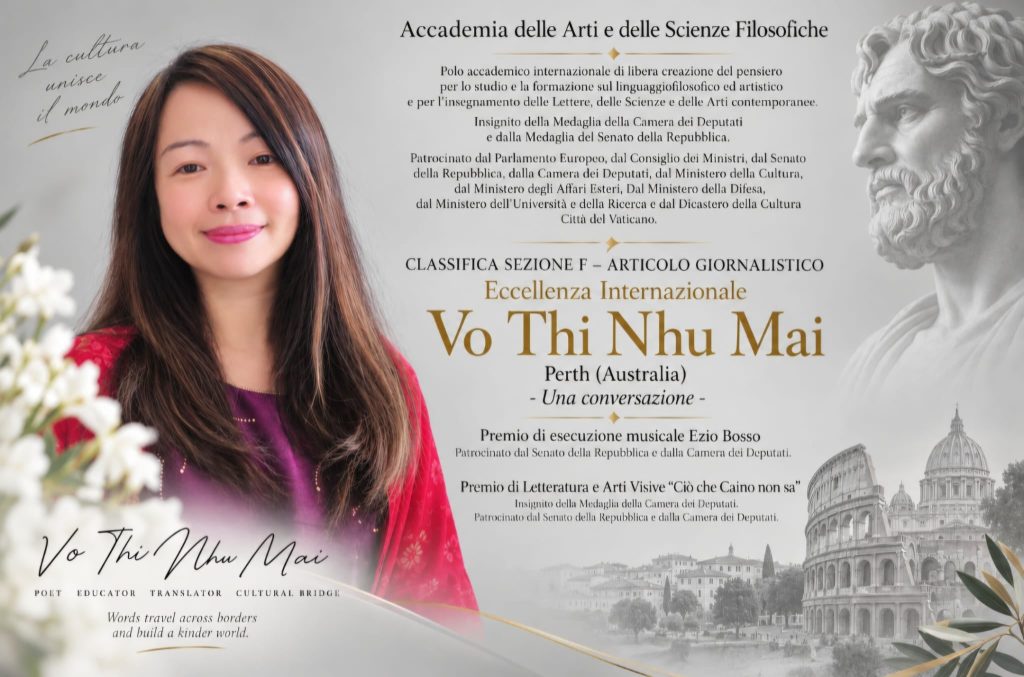
Among the notable international recognitions of the 2026 edition is the achievement of Vo Thi Nhu Mai, who was awarded the distinction of Eccellenza Internazionale in Section F – Articolo Giornalistico for her work “Una conversazione.” Based in Perth, Australia, Vo Thi Nhu Mai’s recognition adds an important international dimension to a category otherwise led by Italian journalists and writers. First prize in the section went to Giovanni Galeone for “Quel giuslavorista difensore di giornalisti e metalmeccanici,” while Serenella Siriaco received second prize for “Riflessioni sul pensiero di Seneca” and Rosanna Affronte received third prize for “Andrei, dalla solitudine della strada a un nuovo inizio.” Additional awards in the section included the Premio Senato Accademia and the Premio “Città di Bari,” demonstrating the range of distinctions available within the competition.
Against this strong field, the Eccellenza Internazionale awarded to Vo Thi Nhu Mai for “Una conversazione” represents a significant acknowledgment of her contribution to contemporary journalistic and literary expression. Her achievement is also meaningful because the Lucius Annaeus Seneca Prize creates a platform where writing can be appreciated beyond national boundaries. The presence of international authors throughout the 2026 results demonstrates the increasingly global character of contemporary literary culture.
The competition recognized writers from countries including Peru, Norway, Serbia, Turkey, Kosovo, Albania, Greece, Bangladesh, Venezuela, China, Ukraine, the United States, Spain and other parts of the world. In the international categories, authors were honored for poetry, narrative and published books, while special distinctions such as Eccellenza Internazionale and Menzione d’Onore acknowledged works that impressed the commission for their literary qualities and international relevance.
Vo Thi Nhu Mai’s recognition therefore sits within a larger cultural exchange in which authors from different countries bring their perspectives, experiences and creative approaches into conversation. The title of her recognized work, “Una conversazione,” itself evokes the central role that dialogue can play in literature and journalism. Writing can open a space in which experiences meet, ideas are exchanged and different perspectives become understandable to one another. In this context, her international recognition is not simply a personal achievement but also an example of how contemporary writing can create bridges between cultures and communities.
The range and quality of the other 2026 award recipients further illustrate the importance attached to literary excellence by the Accademia delle Arti e delle Scienze Filosofiche. In Section A – Poesia, Stefania Siani received first prize for “Figlie del vento,” with Paolo Castagnola and Margherita Flore Satta completing the podium. The section also included special recognitions such as the Premio all’Eccellenza Università degli Studi “Aldo Moro” di Bari, the Premio Senato Accademia, the Premio Presidente di Commissione, the Premio “Città di Bari,” the Premio “Ciò che Caino non sa,” the Premio “Pegaso” and the Premio “Dafne.”
In Section B – Silloge Poetica, Elisabetta Biondi della Sdriscia won first prize for “Il tempo del glicine,” followed by Roberto Bray and Silvia Sillano. Section C – Narrativa awarded first prize to Vincenzo d’Ambrosio for “Profumo di basilico,” with Lucio Schiuma and Luigina Favale taking second and third places. The competition also demonstrated its commitment to journalism through Section F, while Sections G, H and L recognized published poetry, published narrative and literary or scholarly essays. The philosophical dimension of the prize was particularly visible in Section EM – Premio Epistulae Morales, inspired by Seneca’s reflection, “Sii servo del sapere, se vuoi essere veramente libero.” Paolo Luca Bernardini won first prize with “Vera libertas: il sapere o la morte?”, followed by Cristina Offidani and Benedetto Russo.
The student categories also highlighted the importance of encouraging young literary talent, with awards for poetry and narrative demonstrating that the future of literature is being cultivated alongside established voices. Beyond the Seneca Prize itself, the academy’s cultural activities include the Premio di esecuzione musicale Ezio Bosso, supported by the Senate and Chamber of Deputies, and the Premio di Letteratura e Arti Visive “Ciò che Caino non sa,” also distinguished by institutional recognition. Together, these initiatives show a broad understanding of culture in which literature, philosophy, journalism, music and visual arts are interconnected.
The 2026 results consequently represent much more than a conventional ranking of competition entries. They reveal a cultural network in which different generations, disciplines, languages and national backgrounds meet through creative work. The international sections are particularly important in this respect because they demonstrate that literary achievement can emerge from many geographical and cultural environments and that contemporary literature is increasingly shaped by global exchange.
For Vo Thi Nhu Mai, the Eccellenza Internazionale recognition for “Una conversazione” is therefore a noteworthy milestone within the 10th Edition of the Premio Accademico Internazionale di Letteratura Contemporanea Lucius Annaeus Seneca. Her inclusion among the distinguished international award recipients reflects the ability of contemporary writing to travel across borders and to participate in a broader conversation about culture, society and human experience. The recognition also connects her work in Australia with an established Italian literary and academic tradition centered in Bari, creating a meaningful link between different cultural settings.
The award documentation states that works receiving recognition are included in the Premio’s anthology, providing another opportunity for the selected authors to reach readers and become part of the historical record of the competition. The awards are also designed to recognize authors through trophies or plaques and certificates containing the commission’s motivation, according to the relevant category and competition provisions.
The 2026 edition demonstrates that literature remains a powerful medium for dialogue at a time when cultural exchange has become increasingly international. From the Italian winners recognized for poetry, fiction, journalism and scholarship to the authors representing countries across Europe, Asia, the Americas and beyond, the results present a wide panorama of contemporary literary creativity. Within that panorama, Vo Thi Nhu Mai’s international excellence award stands as a distinctive recognition of an Australian-based voice whose work has gained attention within an international literary competition. “Una conversazione” becomes, through its recognition, part of a wider exchange of ideas represented by the Seneca Prize—an exchange in which writing connects individuals who may live thousands of kilometres apart but share an interest in language, reflection and human experience.
The achievement is particularly fitting within a prize inspired by Lucius Annaeus Seneca, whose philosophical legacy continues to encourage reflection on knowledge, freedom, ethics and the human condition. The 10th edition thus closes with a message that is both literary and universal: excellence in writing can cross borders, connect cultures and create opportunities for dialogue. Vo Thi Nhu Mai’s Eccellenza Internazionale recognition is a valuable part of that message, marking her work as one of the international contributions honored by the 2026 Lucius Annaeus Seneca awards and highlighting the continuing role of contemporary literature and journalism in bringing diverse voices into a shared cultural conversation.