 thesilkroadtoday
 Vetrina delle Emozioni
This blog was born from the meeting between Authors and Artists. It is a place where music, writing, and above all poetry find a showcase capable of giving voice to the emotions that you know how to transform into art. An invitation to share and allow your words and notes to reach those who know how to listen.
For suggestions or collaborations: Vetrina delle Emozioni Facebook page
Friday, September 4, 2026
Interview with Paola Carletti, conducted by Gioia Lomasti in collaboration with Vetrina delle Emozioni – Authors & Artists
Interview with Paola Carletti, conducted by Gioia Lomasti, in collaboration with Vetrina delle Emozioni, for 100 Libri d’Autore (100 Author Books), a cultural project curated by Gioia Lomasti and Emanuele Marcuccio.
We sincerely thank Paola Carletti for accepting this interview devoted to her debut novel, La luce oltre il silenzio (The Light Beyond Silence), a work that intertwines introspection, mystery, symbols, and spirituality, telling the journey of someone searching for their own truth beyond appearances and beyond what life seems determined to conceal.
Paola Carletti is an Italian author with a humanities background and a profound passion for stories that explore the inner self, mystery, and the invisible force that guides human destinies. From childhood, she found refuge in books and writing, transforming words into a safe space from which to observe the world with sensitivity and depth, giving voice to what often remains unspoken.
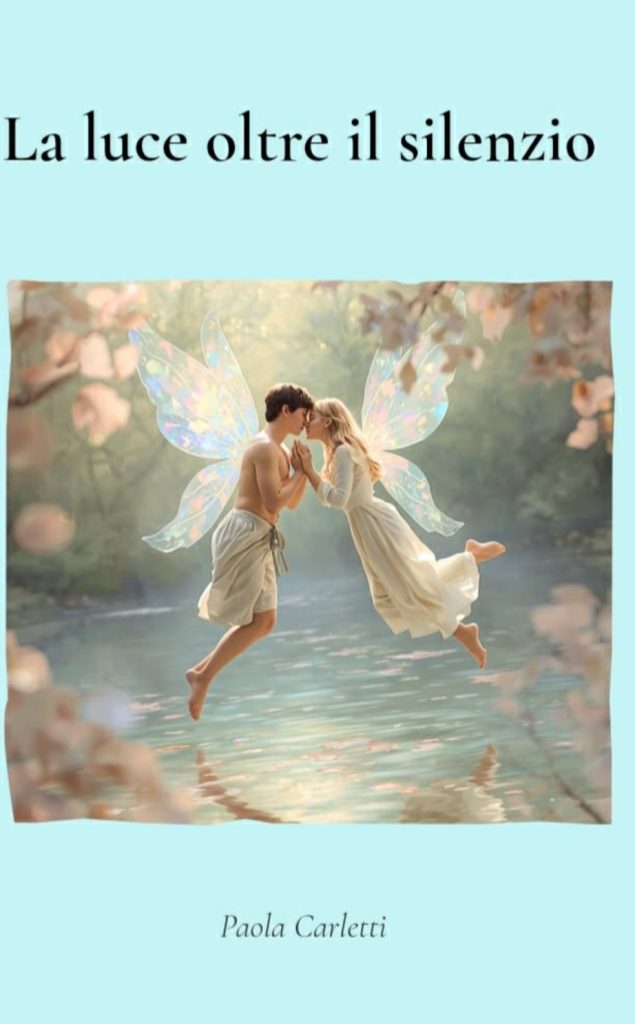
La luce oltre il silenzio is her debut novel, a work that combines introspection, symbolic suggestions, and a touch of spirituality. She lives in Tuscany, is a mother and great-grandmother, and continues to devote herself to writing while working on new narrative projects.
What initial image, intuition, or emotion gave rise to the story told in La luce oltre il silenzio, a novel that seems to emerge from an intimate and silent place within the soul?
The initial image of the novel comes from a dream I had as a child, a dream so vivid that it remained with me over time like a silent trace. It was not a dramatic vision, but rather a profound impression: the feeling that there existed an inner place where something was asking to be heard. From that intuition, which I have kept within me since 1971, came the desire to tell the story of a journey that begins in silence and slowly opens toward the light.
How has your humanities background influenced the construction of the characters and the atmospheres, which are so rich in symbols and inner references?
My humanities education taught me to look at people as complex worlds—different, shaped by symbols, choices, silences, and contradictions. That is precisely what I sought to convey in the characters: not “perfect” figures, but human beings carrying questions within them. The atmospheres emerge from the same root: an intertwining of inner life, cultural references, and small signs that point toward what is not openly expressed.
The novel explores truth beyond appearances. What kind of “light” would you like the reader to discover while moving through the pages of your work?
The light I imagine is not a sudden revelation, nor is it a solution. It is a discreet light that allows us to see more clearly what is already there: our emotions, our questions, the parts of ourselves that often remain in the shadows. A light that does not erase silence, but passes through it.
Spirituality is present as a discreet yet constant force. What role does it play in your writing and in the journey of your protagonists?
Spirituality, in my way of writing, is never a dogma or an answer. It is an inner attitude: the ability to perceive that there is something beyond what we can see. In the protagonists, it becomes a delicate thread accompanying them, a presence that does not guide but supports. A silent force that allows them to move forward even when they do not yet have a clear direction.

From childhood, you found refuge in books and words. How has this relationship with writing evolved over time, until it became a completed novel?
As a child, reading first, and later writing, were a refuge, a protected place. Over time, writing became a way of understanding, of giving shape to emotions, and of moving through what cannot be expressed aloud. Writing a novel was the natural next step: no longer merely a refuge, but a bridge toward others.
What emotion, question, or awareness would you like to remain with the reader after they have journeyed through La luce oltre il silenzio?
I would like a feeling of discreet companionship to remain. Not a lesson, not a moral, but the awareness that every inner journey has its own rhythm and its own dignity. If, upon closing the book, the reader feels that a small light has been kindled within them, then the novel has completed its journey.
Vetrina delle Emozioni
Friday, September 4, 2026
Powered by Blogger
About the Blog
Vetrina delle Emozioni was created to give a voice to art—from music to writing and, above all, poetry—a showcase for making emotions visible.
The blog acknowledges the websites that host and support this reference platform: Vetrina delle Emozioni and Progetto Almax.