 thesilkroadtoday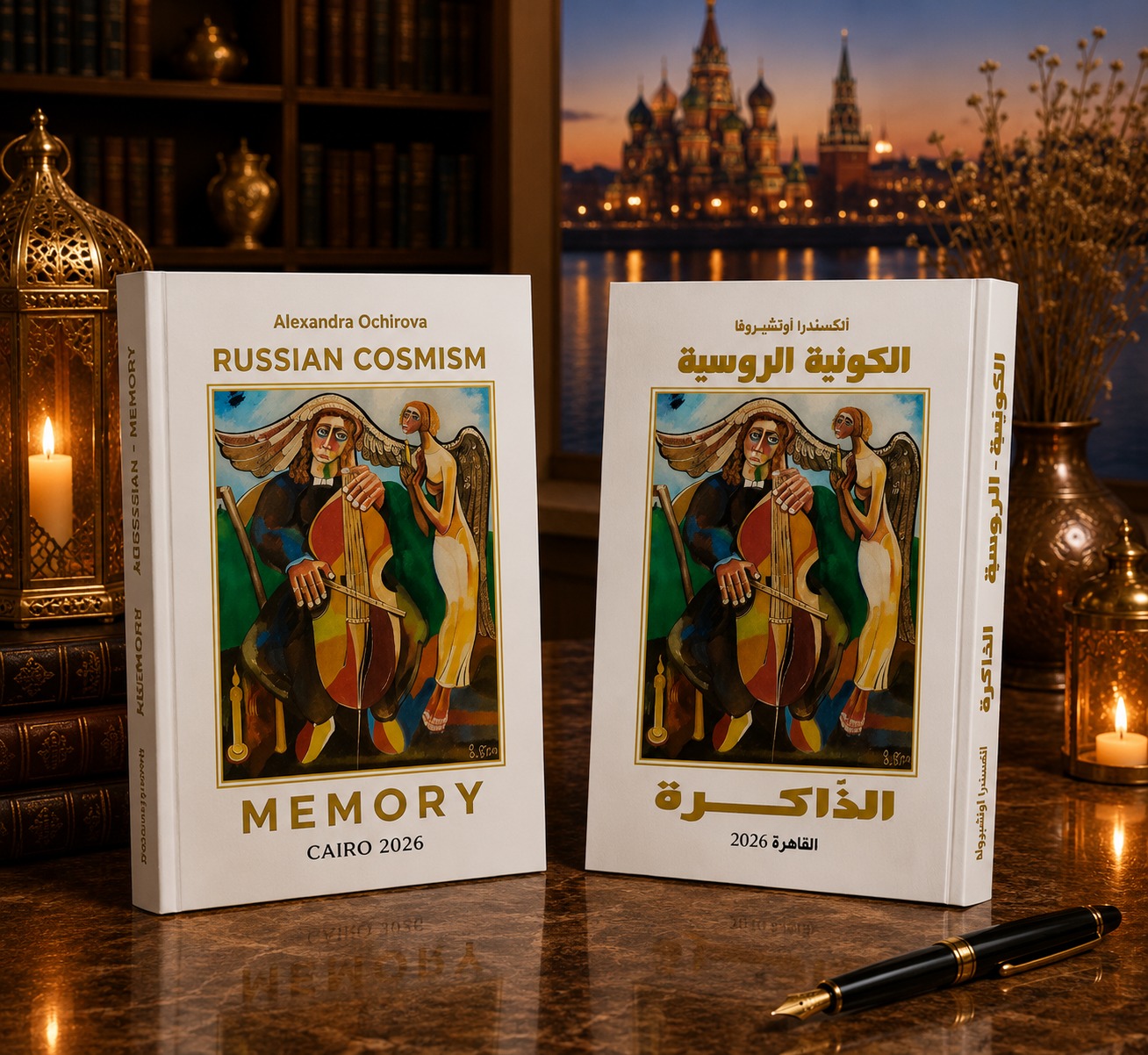
Memory, Time, Family, History and Motherland
By Dr. Ashraf Aboul-Yazid, Egypt

Alexandra Vasilievna Ochirova is a distinguished Russian poet, philosopher, public figure, UNESCO Goodwill Ambassador, RAH Academician, and Doctor of Philosophy and cultural thinker whose work moves across literature, history, and the spiritual dimensions of human civilization.
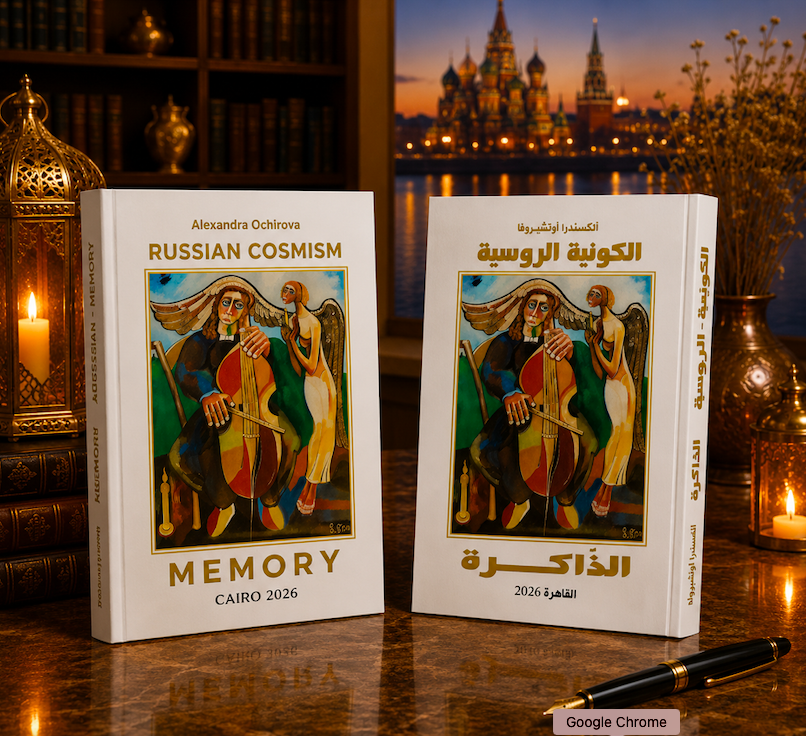
Her poetry is marked by a profound concern with memory, time, humanity, homeland, and the continuity between generations. In Russian Cosmism: Memory, Ochirova develops these concerns into a poetic-philosophical meditation on the human being as a bearer of personal, historical, cultural, and cosmic memory. The book explores how memory resists oblivion, preserves the experience of generations, and connects the fleeting instant with eternity. Family, homeland, history, faith, and the natural world become interconnected dimensions of this larger vision. Rather than treating memory simply as recollection, Ochirova presents it as a living force through which the past remains active in the present and humanity searches for meaning within the vastness of time and existence. The volume is enriched by illustrations by Zurab Konstantinovich Tsereteli.
Alexandra Ochirova’s Russian Cosmism: Memory is difficult to approach as an ordinary collection of poetry. It is at once a poetic book, a philosophical meditation, a spiritual testament, and an extended inquiry into the relationship between the human being and the universe. Its central subject—memory—is never confined to recollection. Memory becomes an active force, a form of knowledge, a moral obligation, and finally a means of resisting death.
The book’s philosophical architecture can be understood through five interrelated pillars: Memory, Time, Family, History, and Motherland. These are not five independent subjects. They form a single ascending structure. Family is where memory begins; history is where memory becomes collective; the Motherland is where collective memory acquires geographical and cultural form; time is the dimension through which all these experiences move; and memory is the force that prevents time from reducing them to oblivion.
The book itself declares this conception with extraordinary directness: “Memory—revelation of immortality, / A power that conquers death.” The statement may be read as the governing thesis of the entire volume. Ochirova does not claim that human beings escape mortality biologically. Rather, she proposes that what is remembered enters another order of existence. Memory becomes the human answer to disappearance.
The English edition identifies the work as a poetic and philosophical meditation on the human being as a bearer of historical, cultural and cosmic memory, placing individual consciousness within larger structures of time and meaning. This is precisely where the book’s deepest originality lies: it begins with the intimate and repeatedly expands toward the universal.
- Memory: The First Principle of Being
The most important conceptual transformation in Russian Cosmism: Memory is the transformation of memory from a passive psychological faculty into an ontological power.
In ordinary usage, memory looks backward. In Ochirova, memory looks simultaneously backward and forward. It retrieves what has disappeared, but it also gives that disappearance a continuing existence. The past is therefore not dead material. It remains active within the present.
The poem “Memory — In Full Stature” establishes this idea:
“Memory in full stature—
And on its knees before God,
In the image of all ages,
Of generations gone forever…”
The poem then reaches its decisive formulation:
“Memory—revelation of immortality,
A power that conquers death.”
The theological language is important. Memory is “on its knees before God”; therefore remembrance is not simply an intellectual act but a moral and spiritual one. To remember is to acknowledge that human existence possesses a value exceeding its physical duration.
The poem “A Premonition That You Stand Alone” deepens the argument by presenting memory as what remains when all external securities disappear:
“And only memory remains.
It always draws from out the past
All that was truly yours.”
The past becomes a reservoir of identity. The phrase “truly yours” is especially significant. Memory does not merely preserve facts; it retrieves the elements through which the self recognizes itself. This leads to one of the book’s fundamental paradoxes: memory is simultaneously a consolation and a wound. It saves what has vanished, but precisely because it saves it, it reminds us that what is remembered cannot physically return.
That tension is devastatingly expressed in “Irreplaceable Loss,” written in memory of the poet’s grandmother. The speaker says:
“Everything returned. And yet the world became empty.
And only one thing never returned—Myself.”
Here memory does not restore the lost person. It restores images, sensations, places and emotional traces, but the self that existed before the loss cannot be recovered. Memory therefore preserves absence as much as presence.
This is perhaps one of the book’s most mature insights: to remember is not to defeat loss; it is to give loss a form in which it can continue to speak.
- Time: The Meeting Place of the Mortal and the Eternal
If memory is the book’s central force, time is its great philosophical problem. Ochirova repeatedly refuses the ordinary linear conception of time. In her poetry, past, present and future overlap. A minute can contain eternity; a childhood moment can survive decades; a historical event can remain alive in the consciousness of descendants. The book’s section “Where Time Is Eternity and a Minute” announces this paradox in its title. Elsewhere the poet writes:
“The definition of Being,
And the inaccessibility of the Absolute,
Where eternity and minute dwell together.”
This is not simply decorative paradox. It is the metaphysical principle of the collection. The smallest human moment can become a vessel for infinity.
In “Infinity Encountered a Minute,” the paradox becomes intimate:
“Infinity encountered a minute
Along the road, at its very end,
Where one can neither forget nor confuse
The eternal gaze of a beloved face.”
The “beloved face” gives eternity a human scale. Infinity is no longer an abstract cosmic concept; it is encountered in recognition, love and memory. The later section devoted explicitly to Time makes the argument even clearer. Ochirova writes:
“Time is that which is, and shall remain.
That which has been, existed without us too.”
Time is therefore larger than the individual. Human beings enter it, inhabit it temporarily, and leave it. But the poet immediately links time to memory:
“Time is the precision of measured measure,
The memory of all—the gone and the living,
In the dates of life, of death, and birth,
With their continuation in eternity.”
Here time becomes an archive. It records birth and death, but memory prevents those records from becoming meaningless chronology.
The poet’s deeper proposition is that eternity does not abolish time; eternity is revealed through time. The minute matters because it is the form in which the infinite becomes accessible to human consciousness.
This is why the book repeatedly moves between astronomical images—stars, planets, galaxies, orbits—and intensely personal memories. The cosmic scale does not cancel the human scale. Instead, the cosmic gives the human moment greater significance.
III. Family: The First Archive of Memory
The most moving dimension of Russian Cosmism: Memory emerges when the cosmic philosophy returns to the family.
The family is the first place where history becomes personal. Before the individual knows nations, wars, civilizations or cosmic laws, there is a mother, a father, a grandmother, a childhood home. Family is therefore the first archive.
The poem beginning “I wake— / And with my very first word, Mother” is central to understanding this dimension. The mother is remembered not through grand historical events but through ordinary gestures:
“She always rose before the dawn,
Prepared my morning meal,
And braided for school
My hair.”
The simplicity is deliberate. The poet discovers metaphysical continuity inside domestic routine.
The mother’s inheritance is described as:
“That precious memory of days,
Of all that lived
In her alone…”
And then comes the decisive transformation:
“And her redeeming essence
Of love
Becomes my talisman—
Like Alpha and Omega.”
The mother therefore becomes both beginning and end—“Alpha and Omega.” Family memory acquires a sacred dimension.
The following poem intensifies the theme of inheritance. Without the mother’s eyes and hands, the speaker must enter “another circle” and “another height,” yet remain herself. The child continues to exist within the adult:
“A child’s small hand
Still held
The genome
Of inherited grace.”
This “genome” is obviously more than biology. It is cultural, ethical and emotional inheritance. The mother survives through the qualities transmitted to the child. This makes family in Ochirova’s poetry something much larger than genealogy. Family is the first mechanism through which civilization reproduces itself. A mother transmits not merely life but memory, values, gestures, prayer and identity.
The grandmother’s death reveals the opposite side of the process. In “Irreplaceable Loss,” memory becomes an attempt to gather together “all the strength of memory and feeling,” yet the poet concludes that something irretrievable has happened. The family is thus where immortality and mortality collide most painfully.
- History: The Past as Moral Responsibility
If family is intimate memory, history is memory enlarged into civilization.
Ochirova’s historical imagination moves freely across Russian history, classical antiquity, Christianity, mythology, war, literature and cultural memory. Carthage, Rome, Homer, Prometheus, Odysseus, Russia’s wars, fallen soldiers and forgotten generations all inhabit the same poetic universe. But the poet does not treat history as a museum of dead facts. History is a moral field in which the present is constantly judged by the past.
In “Interpretations—Of Truth and Myth,” she writes of:
“The ages that gave birth to minds”
and then warns of the falsification of remembrance:
“The fatal ‘generosity’ of memoirs,
That crucified the truth—exactly as it was.”
This is a remarkably important critical statement. The book does not blindly celebrate memory. It recognizes that memory can be manipulated. Memoirs can distort; political narratives can conceal; historical glory can become spectacle.
The poem therefore introduces a tension between remembering and mythologizing. The later “Chronicle” makes the poet’s position even clearer:
“Pictures of the world, painted in words,
Have kept it all—both feelings and minds.”
Writing becomes a historical vessel. Words preserve what physical civilization cannot guarantee will survive.
Yet the poem immediately asks where the traces of history now exist. The question suggests that monuments alone cannot preserve meaning. History survives only when it remains intellectually and morally alive.
This is why Ochirova repeatedly connects memory with knowledge. Her portrait poem culminates in the transformation of historical experience into:
“Both memory
And knowledge.”
The distinction is crucial. Memory without knowledge can become nostalgia; knowledge without memory can become sterile abstraction. Ochirova’s project is to unite them. Her historical poetry therefore performs an ethical function: it asks the living to inherit responsibility for the dead.
- Motherland: Geography as Memory
The fifth pillar, Motherland, is where the personal and historical dimensions of memory become geographical. Ochirova’s Motherland is not simply a political territory. It is a landscape saturated with childhood, ancestors, churches, bells, rivers, villages, soldiers, graves, language and inherited cultural consciousness.
In “My Home Remained Forever There,” the home becomes:
“A living memory of ancestral generations.”
The soldiers who leave for war carry with them the desire to return to:
“their father and their mother”
and to experience again:
“The peace of native ground…”
The homeland therefore exists simultaneously as physical soil and remembered belonging. Even before the soldier returns, the homeland survives within him as dream. The poem concludes with sons becoming:
“eternal memory.”
This is a crucial movement: the Motherland remembers its people, but the people also remember the Motherland into existence.
The title poem “Homeland” condenses the idea:
“A house bent low from the weight of the past…”
The house is almost a body carrying history. The past has physical weight. The speaker then addresses the land directly:
“All that I am, I can give to you,
My land…”
The relationship is reciprocal. The individual receives identity from the land and returns identity to it through memory, sacrifice and artistic expression.
The poem’s final movement—people prepared “to die for you, / And to be born anew with you”—makes the Motherland a space of continuity between death and rebirth.
This is where Motherland meets Russian Cosmism. The nation is not the final horizon. It is one stage in the larger cosmological cycle through which human beings seek continuity beyond individual mortality.
- The Five Pillars as One Structure
The deepest achievement of Russian Cosmism: Memory lies in the way these five themes continuously merge.
Family gives memory its first face.
Memory gives history its human meaning.
History gives the Motherland its depth.
The Motherland gives memory a landscape.
Time gives all of them continuity.
The structure may be represented as a circle rather than a straight line.
The child remembers the mother.
The adult remembers the child.
The family remembers its dead.
The nation remembers its heroes.
Humanity remembers its civilizations.
The poet remembers all of them.
And the cosmos becomes the final horizon within which remembrance seeks permanence.
This explains why the poet can move naturally from a mother preparing breakfast to stars, from a grandmother’s death to eternity, from Russian battlefields to cosmic light. The apparently enormous distance between these subjects is actually the point. Ochirova’s poetic universe insists that nothing meaningful is isolated. The domestic and cosmic are two scales of the same existence.
VII. Memory Against Oblivion
The book can ultimately be understood as a long poetic resistance to oblivion.
This resistance is particularly powerful because Ochirova does not deny death. Death appears everywhere: in war, old age, family loss, historical destruction, vanished civilizations and the inevitable passage of generations.
Instead, she asks what human beings can do in the presence of death. Her answer is remembrance. In “In Memory of a Pilot,” the pilot “has finally returned home,” while what remains are:
“feats and battles,
Echoing long through mountain memory,
And prayers that always rescued,
Faith that conquered fear.”
The word “home” is significant. Death is paradoxically represented as a return. This returns us to the central cosmological idea: existence is not simply a movement from birth toward disappearance; it is a passage into another form of continuity.
The fallen are therefore not merely dead. They become memory.
In the poem “In Memory of the Fallen,” remembrance is explicitly ritualized through the eternal flame, the grave, the obelisk and prayer. The individual life becomes part of a collective historical consciousness. The poet’s imagination consequently creates a hierarchy of remembrance:
the remembered individual → the family → the community → the nation → humanity → the cosmos. This is the architecture of the book.
VIII. The Mother and the Motherland: An Intentional Parallel
One of the most compelling critical observations in the collection is the parallel between mother and Motherland.
The mother gives birth to the individual. The Motherland gives historical birth to collective identity. The mother protects through prayer. The Motherland protects through memory, culture and inherited belonging. The mother is remembered through childhood gestures. The Motherland is remembered through landscapes, bells, rivers, villages and ancestral graves.
The similarity is not accidental. The very concept of “Motherland” depends upon maternal imagery. Ochirova intensifies that linguistic and emotional connection by placing the two forms of motherhood inside the same poetic universe. Thus, when the poet writes about the mother’s “inheritance,” she is also preparing the reader to understand cultural inheritance. The maternal inheritance becomes a miniature model of civilizational inheritance.
This is one reason the book’s political and historical passages cannot be separated from its intimate poetry. The same emotional mechanism is operating at both levels: love becomes responsibility because what is loved must be remembered.
- History, Truth and the Problem of Memory
There is, however, a productive tension within the book that deserves critical attention. Ochirova often writes in the language of sacred memory—heroes, sacrifice, homeland, faith and eternal remembrance. Yet elsewhere she questions the reliability of historical narratives. Her statement about memoirs that “crucified the truth” introduces suspicion into the very act of remembering.
This tension makes the book more intellectually interesting. Memory is necessary—but memory can lie. History must be preserved—but history can be manipulated. The Motherland must be loved—but historical love can become mythology. The poet does not resolve these contradictions through historical methodology. Instead, she subjects them to poetic consciousness. Poetry becomes the place where remembrance can remain emotionally truthful while acknowledging the incompleteness of human knowledge.
This is consistent with the book’s cosmism. The universe itself exceeds human understanding. Consequently, the poet repeatedly returns to questions rather than final answers.
The title “I Find No Simple Answers” is therefore almost a methodological statement. The poet’s universe is not a closed philosophical system. It is a field of questions in which memory, faith, science, history and poetry intersect.
- Poetry as a Technology of Continuity
The final section of the book returns to the Word itself.
Ochirova writes:
“Pictures of the world, painted in words,
Have kept it all—both feelings and minds.”
The poet therefore attributes to language a preservative power. Words become a technology of cultural survival. This is why the book repeatedly links poetry to prayer. Poetry is not merely aesthetic ornament. It is a form of preservation. In “Word,” the poet writes of birth, death, endurance, memory and goodness, finally arriving at the theological declaration:
“And in the beginning of the Word—was God.”
The Word becomes the point at which human memory touches divine creation. This also explains the importance of the book’s visual dimension. The English edition contains illustrations by Zurab Konstantinovich Tsereteli, and the edition itself presents image and poetry as two parallel paths toward understanding existence. The visual artwork therefore participates in the same struggle against disappearance. Art, like memory, gives form to what time threatens to erase.
Memory as the Human Form of Eternity
Russian Cosmism: Memory is ultimately a book about the human desire not merely to survive death, but to ensure that existence has meaning after individual existence has ended.
Its five pillars—Memory, Time, Family, History and Motherland—form a single philosophical continuum. Memory preserves. Time tests. Family transmits. History judges. Motherland embodies. And poetry gives all five a language capable of crossing generations.
The most profound proposition of the book is therefore not simply that memory defeats death. It is that memory transforms death into continuity. The mother dies, but her gestures survive. The grandmother disappears, but her absence becomes memory. The pilot dies, but his flight becomes testimony. The soldier falls, but his name enters historical remembrance. Civilizations collapse, but their traces survive in art and language. The individual passes, but consciousness seeks continuation within humanity. And humanity itself appears within the vastness of the cosmos.
This is why the book’s most important movement is always from the small toward the immense. The child’s hand contains “the genome / Of inherited grace.” A house contains generations. A homeland contains history. A minute contains eternity. A remembered face can contain infinity.
Ochirova’s achievement is to make these not contradictions but correspondences. Her Russian Cosmism: Memory can therefore be read as a poetics of continuity: an attempt to construct, through verse, a bridge between the fragile human moment and the permanence of the cosmos.
The poet does not promise that the dead will return. She proposes something more subtle and perhaps more powerful:
They can remain.
They remain in the family.
They remain in history.
They remain in the Motherland.
They remain in language.
They remain in memory.
And, through memory, the human being discovers a form of eternity.