 thesilkroadtoday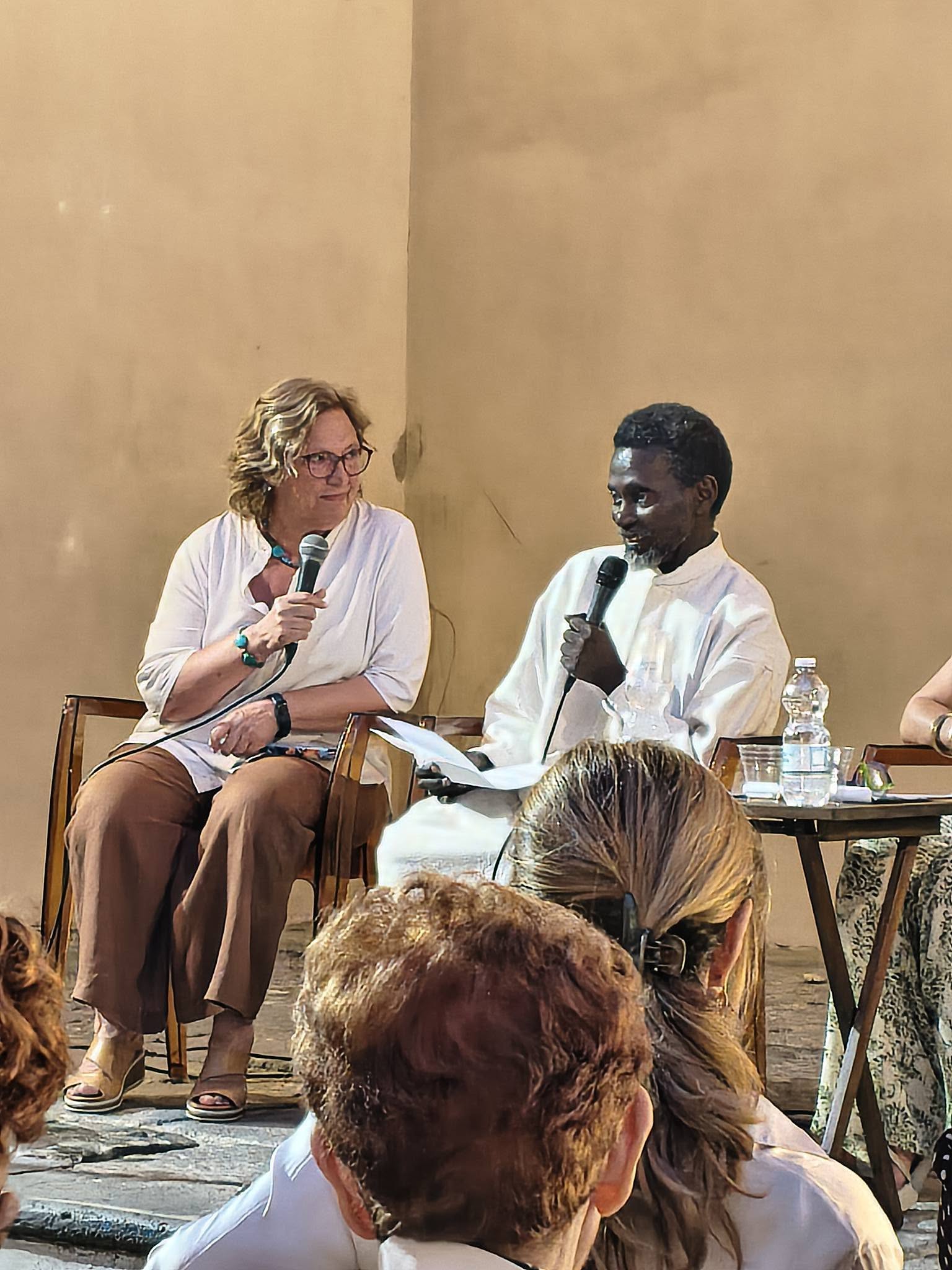
Tuesday, June 23, 2026 – Il Mattino
By Erminia Pellecchia
“In the poems written here and there, I do not paint this world through which I merely pass; I paint myself within the world, and through this I can say to the reader—my companion in wandering—that I am entirely myself in this book.”
These words are taken from the preface to Tebrae (Darknesses), a remarkable work by Malian poet and philosopher Ismaël Diadié Haïdara, better known as Ismaël Qûti. The collection consists of two-line poems composed in the Hassaniya language, following a poetic form traditionally practiced by the women of the desert. Written on scraps of paper and in the margins of books and notebooks during the years of exile between 2011 and 2021—the year of its publication in Spain, where he now lives—the poems have been brought together in a single volume.
The book has been masterfully translated by Rossella Nicolò and Giancarlo Cavallo for Casa della Poesia and inaugurates the series Poetry Like Bread, a collection marking the thirtieth anniversary of the cultural institution founded by Sergio Iagulli and Raffaella Marzano. The series enriches the historic catalogue of the Baronissi-based literary residence with new and diverse voices.

 As the founders describe the poets featured in the collection:
“These great migratory birds, who are poets, gift us through their flight a part of the places from which they come—so different from exotic postcards and the plastic villages created for hurried tourists.”
Presented in preview yesterday at the Institute for Philosophical Studies in Naples, the volume arrives tonight in Salerno, where Haïdara will appear at the Arco Catalano at 8:30 p.m. There, one of the most distinguished living representatives of African poetry and culture will present and read passages from Tebrae, his first book published in Italian, retracing the path of his ancestors.
Born in Timbuktu in 1957, Haïdara descends from the family that has safeguarded the Fondo Kati, one of West Africa’s most important collections of manuscripts. He has dedicated his life to preserving the historical and literary memory of Mali.
A Fertile and Powerful Writing
Tebrae is far more than a simple collection of poems. It is a journey through exile, memory, love, and the search for meaning in a world marked by war, migration, and human fragility. Bringing together 1,203 tebrae, the work pulses with a fertile, burning, and musical style, rhythmic like the beat of a drum.
These poems are fragments of reflection on existence itself, where the intense seasons of human experience move toward new latitudes of being, and words transform into a dazzling song of life.
“Verses that can be read starting from any point in the book,” explain the translators and editors. “There is no logical or chronological sequence; it is life dancing upon invisible threads.”
Haïdara’s poetry is essential, intense, and universal, capable of transforming the pain of uprooting into profound insight. “My homeland is exile,” he writes, in an expansive vision where the tragedy of war coexists with the lightness of a butterfly, the memory of the dead with the song of a cricket in the night, and nostalgia with the sudden joy of a ray of sunlight.
The poet observes the world with a gaze that is disenchanted yet never despairing. Nature continuously becomes a mirror of the human soul: herons, stars, wind, dunes, and trees accompany reflections that transcend geographical and cultural boundaries.
Reading Tebrae means accepting an invitation to slowness and attentive listening. In an era dominated by speed and noise, Haïdara offers words that ask to be savored one by one, like capsules of wisdom. He proposes no absolute truths, but rather questions. He constructs no philosophical systems, but images that linger in memory. He speaks to everyone because he narrates what unites all human beings: the fragile and wondrous passage of life between two infinities.
All rights reserved.
Casa della Poesia publishes the verses of the Malian author, presented today at the Arco Catalano.