 thesilkroadtoday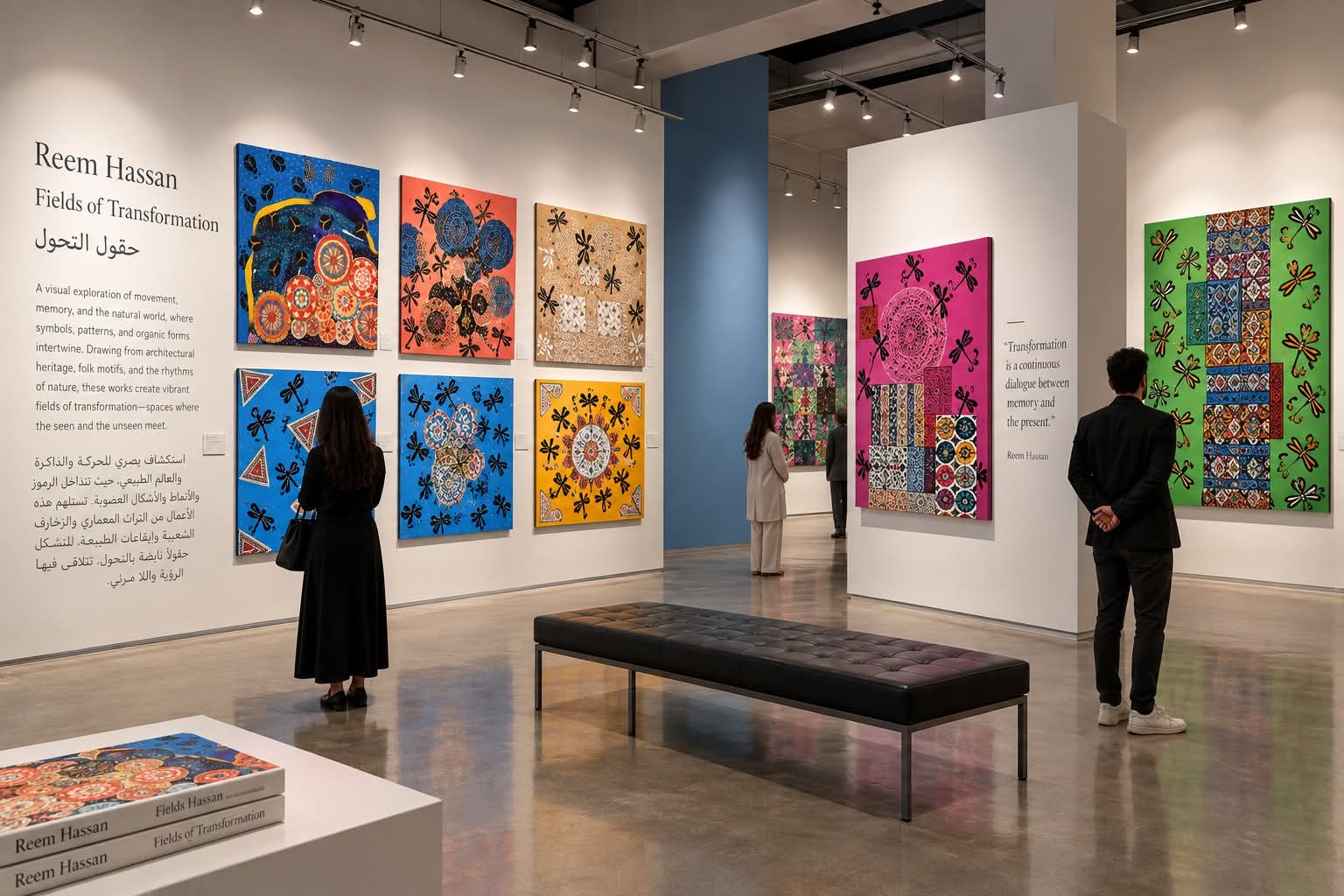
 Reem Hassan and the New Power of the Artist
For decades, the gallery has occupied a privileged position in the visual arts. It has not merely provided walls on which paintings could hang; it has helped determine which artists should be seen, which works deserve attention, and under what circumstances art should enter public life.
But what happens when the artist no longer waits for the gallery to open its doors?
Egyptian visual artist Reem Hassan poses precisely this question. Her reflection, provocatively titled “Giving Up the Gallery as an Institution,” is not a declaration that galleries have become useless. It is something more unsettling: a challenge to the assumption that the gallery must remain the indispensable intermediary between the artist and the public.
Her experiment begins with an apparently simple fact.
The exhibition she presents never actually happened.
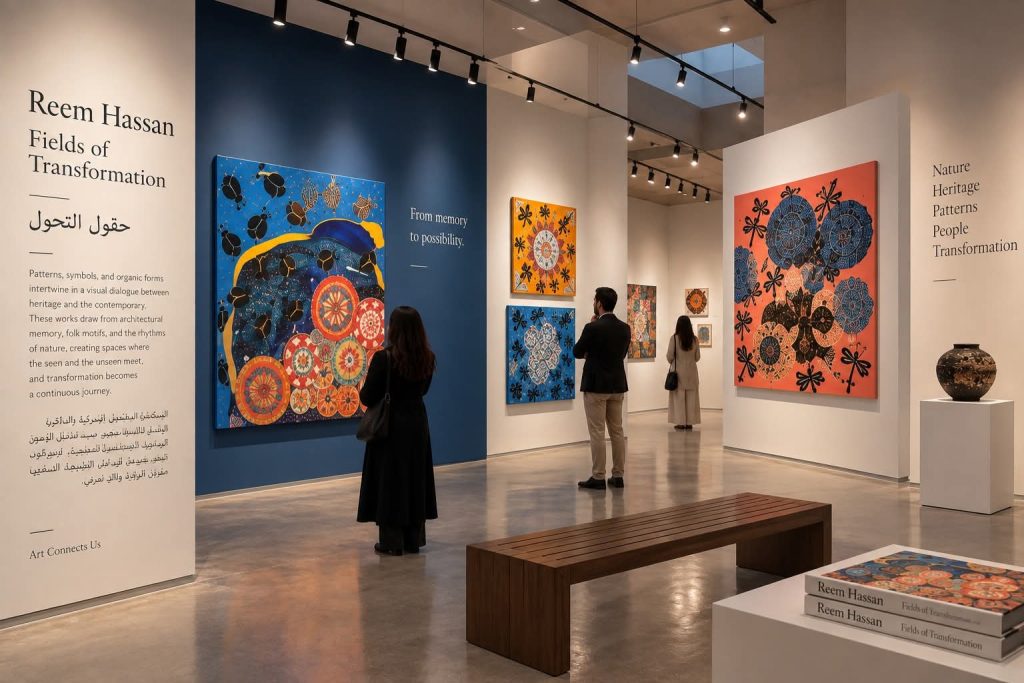
The paintings remained in her studio. The walls were digitally constructed. The visitors never physically stood before the works. Yet the exhibition can be seen, imagined, examined, and experienced.
This is where the traditional hierarchy begins to crack.
For generations, the artist produced the artwork while the gallery controlled much of what came next. The gallery selected, arranged, illuminated, promoted, contextualized, and introduced the work to its intended audience. The artist crossed from the private space of the studio into the public space of the art world through an institutional doorway.
Hassan is asking whether that doorway is still necessary.
The End of the Gatekeeper?
The question becomes especially powerful in the age of artificial intelligence.
AI-assisted visualization can allow an artist to construct an exhibition before physically mounting one. Works can be placed in different environments, relationships between paintings can be tested, lighting can be imagined, distances can be altered, and alternative curatorial arrangements can be explored.
The artist is no longer simply making an artwork.
She can also construct its exhibitionary context.
That distinction matters.
An artwork does not communicate only through its material surface. Its meaning is shaped by placement, sequence, scale, lighting, architecture, neighboring works, accompanying texts, and the expectations of the audience. Whoever controls these elements exercises a degree of interpretive power.
For a long time, galleries exercised much of that power.
Now the artist can begin to reclaim it.
The implications are therefore institutional, not merely technological.
Hassan’s virtual exhibition asks us to reconsider who possesses the authority to say: “This is an exhibition.”
Must an institution validate the experience?
Must a physical gallery provide the walls?
Must a curator construct the sequence?
Must a collector be present?
Or can the artist herself establish the framework within which the work becomes visible?
From Representation to Self-Institution
The most interesting aspect of Hassan’s proposition is that she does not simply replace one exhibition venue with another.
She potentially transforms the artist into a self-institution.
The artist can produce the work, design the exhibition, construct its visual identity, publish it, distribute it, communicate with audiences, and document it. A practice that once required several institutional intermediaries can increasingly be assembled by the artist herself.
This is a profound redistribution of cultural power.
Yet it would be naïve to assume that digital independence automatically produces institutional independence.
The gallery performs functions that a virtual exhibition cannot simply erase.
It can provide professional networks, collectors, curatorial relationships, conservation expertise, critical legitimacy, physical space, and sustained market infrastructure. A digital exhibition can create extraordinary visibility without necessarily creating lasting institutional recognition.
There is therefore a distinction between visibility and validation.
The internet can make an artist visible.
It does not automatically determine how that visibility will be interpreted, preserved, valued, or incorporated into art history.
The Gallery Is Not the Wall
This is perhaps where the debate becomes more interesting.
If the gallery’s only function were to provide walls, then its future would indeed appear precarious.
But the gallery is not the wall.
The gallery is a network of relationships, knowledge, economic structures, curatorial choices, reputational systems, and physical encounters.
And yet this is precisely why Hassan’s argument remains important.
Once artists can provide some of these functions themselves, galleries can no longer assume that their historical role is automatically indispensable.
The question changes from:
“How can the artist enter the gallery?”
to:
“What can the gallery offer an artist who can already reach an audience?”
That is a very different balance of power.
The Screen Cannot Become the Painting
There is, however, a necessary resistance to technological triumphalism.
A digital image is not a painting.
A screen cannot reproduce the physical scale of a monumental canvas, the texture of pigment, the irregularity of a surface, the material presence of an object, or the bodily sensation of standing before an original.
A virtual exhibition can simulate spatial relationships, but simulation is not material presence.
Hassan does not need to deny this distinction—and wisely does not.
Her argument is more sophisticated.
She is not asking whether the virtual exhibition can replace the physical artwork.
She is asking whether the artist must depend upon the gallery in order to begin the process of exhibition at all.
That question is much harder to dismiss.
Escaping One Gatekeeper, Entering Another
There is another contradiction that must be confronted.
The artist may escape the gallery only to encounter a new system of gatekeepers.
Digital platforms have their own algorithms, commercial interests, recommendation systems, metrics, and hierarchies of visibility. What appears to be an open digital space is not necessarily a neutral one.
The gallery once controlled the door.
Today, the algorithm may control the window.
And artificial intelligence introduces another layer: the tools through which artists construct virtual exhibitions are themselves developed and controlled within technological ecosystems that the artist does not necessarily own.
Thus, the real question is not simply whether artists can bypass galleries.
It is whether they can gain greater control over the conditions of their visibility.
From Permission to Choice
Perhaps this is the most consequential change suggested by Hassan’s experiment.
The artist does not necessarily have to reject the gallery.
She can simply stop treating it as the only possible route.
That distinction changes everything.
A gallery can become a choice rather than a requirement.
An artist may choose to work with a gallery because of its curatorial expertise, collectors, physical space, reputation, or international network. Another artist may choose a different model. A third may combine both: physical galleries for selected exhibitions and independent digital spaces for projects that require greater autonomy.
The future may therefore belong neither entirely to the gallery nor entirely to the virtual exhibition.
It may belong to hybrid artistic ecosystems in which institutional representation becomes one component of an artist’s practice rather than its compulsory foundation.
Who Needs Whom?
This brings us back to Hassan’s most provocative question:
When the artist no longer needs the gallery, who needs the other more?
There is no single answer.
But the question itself represents a significant cultural shift.
For much of modern art history, the artist needed access to institutions.
Now institutions increasingly have to explain what they offer beyond access.
That does not mean the gallery has become obsolete.
It means that its authority can no longer be taken for granted.
The most interesting consequence of artificial intelligence and digital exhibition-making may therefore not be that they destroy galleries.
It may be that they force galleries to redefine their reason for existing.
The gallery of the future may have to become less of a gate and more of a partner; less of a distributor and more of a curator; less of an authority that grants visibility and more of an institution that creates meaningful encounters.
And the artist may finally be able to enter that relationship from a different position—not as someone waiting to be admitted, but as someone who already possesses a space of her own.
Reem Hassan’s virtual exhibition is therefore more than an experiment in artificial intelligence.
It is an experiment in artistic sovereignty.
The white wall may remain.
The gallery may remain.
The curator may remain.
The collector may remain.
But the assumption that the artist must wait for permission to become visible may no longer remain.
And perhaps that is the real revolution.
Dr. Ashraf Aboul-Yazid
2026