 thesilkroadtoday
International Translation Day 2026 is a reminder that translation is not simply the transfer of words from one language to another. It is literary interpretation, cultural preservation, and a form of bridge-building between people who may never otherwise encounter one another’s voices.
This year, The Rhythm of Vietnam recognized five translators whose work reflects that mission. Founded in 2005, The Rhythm of Vietnam describes its work as two decades of literary anthologies and cultural exchange and identifies its publication under ISSN 3083-5445.
KVI Network is honored to recognize the five honorees selected for the 2026 International Translation Day awards. This feature highlights their professional backgrounds, translation work, and contributions to cross-cultural literary exchange.
Five translators. Five cultural regions. One shared responsibility: carrying language, literature, memory, and human experience across borders without erasing where they came from.
International Translation Day Award 2026 — Honorees
Australia
Juan Garrido Salgado
English ↔ Spanish
ITV-26-JGS7K
French Guiana / France
Alexandra Cretté
English → French
ITV-26-AC4M2
India
Nandita Samanta
English ↔ Bangla; Hindi → English
ITV-26-NS8P6
Egypt
Ashraf Aboul-Yazid
English and other languages → Arabic
ITV-26-AA3R9
Brazil
Marcos Freitas
Poetry, literature & cultural exchange
ITV-26-MF6T4
Juan Garrido Salgado — Australia

Award ID: ITV-26-JGS7K
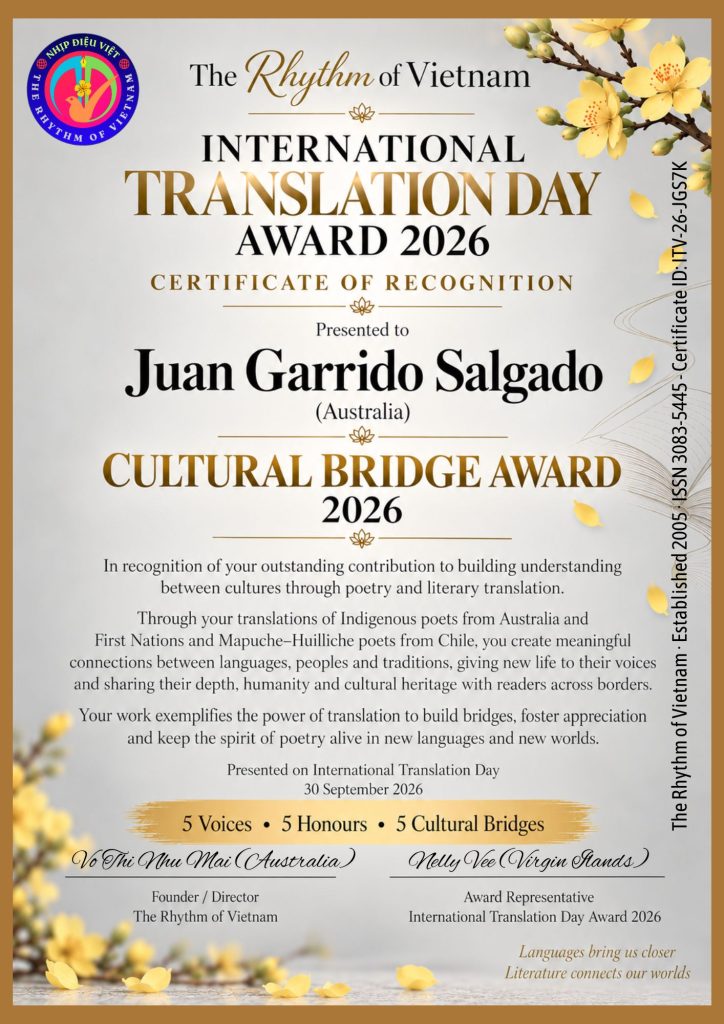
Juan Garrido Salgado translates between English and Spanish. He describes literary translation as a process of carrying the language, sound, rhythm, meaning, and beauty of a poem into another language without stripping it of its life. For him, translation functions as a bridge between two languages, two cultures, and the poets whose work moves between them.
“Breathing life into a poem with two wings, or two languages, for a single flight.”
— Juan Garrido Salgado
His translation work has been shaped in part by his engagement with Indigenous poetry. He has translated a significant number of Indigenous poets between English and Spanish, including work involving First Nations voices in Australia and Mapuche-Huilliche poets from Chile. He emphasizes the importance of understanding not only the words of a poem, but also the culture, circumstances, collective memory, and humanity surrounding the original voice.
In explaining why the International Translation Day Award matters to him, Garrido Salgado highlighted the discipline behind translation: extensive reading, knowledge of languages, familiarity with poets and their cultural circumstances, and the willingness to accept translation as an ongoing challenge. His position is that a translated poem can become a vehicle for communication, cultural understanding, and a renewed life for the original work in another linguistic world.
Alexandra Cretté — French Guiana / France
Award ID: ITV-26-AC4M2
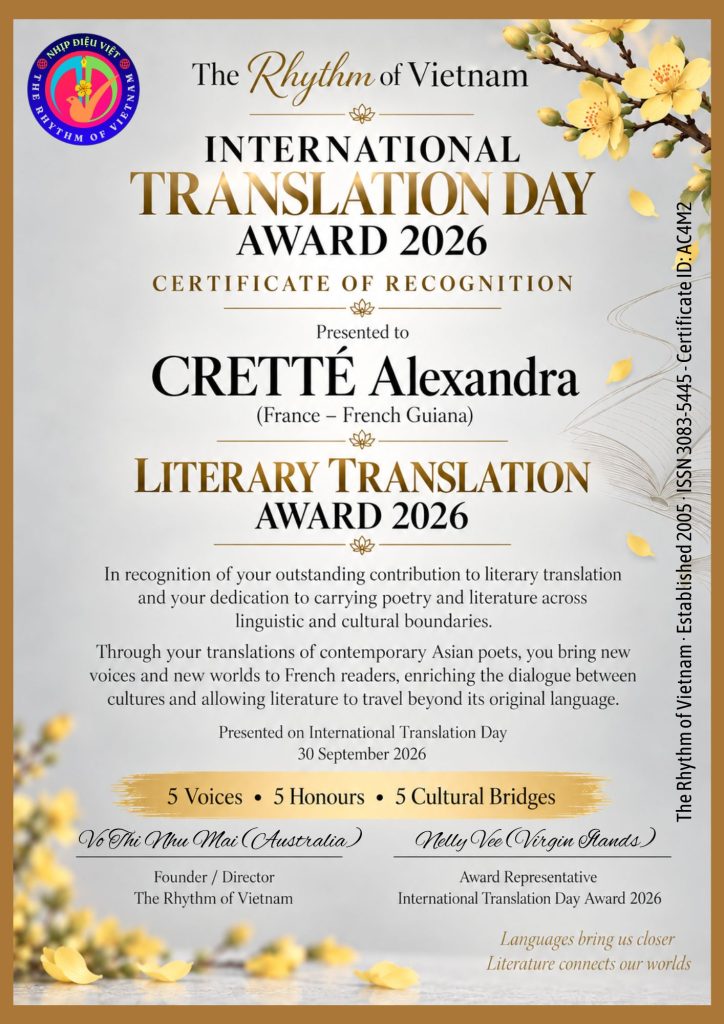
Alexandra Cretté translates from English into French. She has published two collections of translated poetry through Éditions du Cygne in Paris: Embargo, by Nepalese poet, publisher, and academic Keshab Sigdel, and In My Blissful Heart, Though All Is Lost, a collection by Bangladeshi poet, novelist, and publisher Aminur Rahman.
Cretté is also undertaking the substantial task of translating Cao Shui’s Epic of Eurasia, a project that further reflects her sustained engagement with Asian literature and cross-cultural literary exchange.
Her work reflects an intellectual and artistic connection with the cultures and languages of Asia. Rather than treating culture as something that can be flattened into a simple universal experience, she is interested in the permeability of cultural spaces—the way ideas and literature can cross borders while still retaining difference, complexity, and identity.
For Cretté, recognition through the International Translation Day Award affirms that long-term relationship with language, literature, and the cultural worlds she works to bring into French.
“The permeability of cultural spaces, without harbouring the illusion of a simplistic universalism.”
— Alexandra Cretté
Nandita Samanta — India

Award ID: ITV-26-NS8P6

Nandita Samanta works across several language directions: English to Bangla, Bangla to English, and Hindi to English. She has translated nine books.
Her completed work includes a poetry collection translated from Hindi into English; two poetry collections translated from English into Bangla, involving Malaysian and German poets; five poetry books translated from Bangla into English; and a short-story collection translated from Bangla into English.
Her current work includes a project involving a book on mental health moving from French into English, along with additional translation projects in development.
Samanta describes translation as much more than a literary exercise. Her approach begins with listening—to another language, another culture, and another human experience—and then carrying that voice across linguistic boundaries without losing what gives it character.
“Translation has never been merely a literary exercise for me.”
— Nandita Samanta
As both a creative writer and translator, she sees translation as a meeting place for different literatures. Her goal is to help voices, especially those deserving broader readership, enter new linguistic and cultural spaces. For her, the award represents more than recognition: it supports the idea that translation can serve connection, empathy, continuity, and sustained cultural exchange.
Ashraf Aboul-Yazid (Ashraf Dali) — Egypt
Award ID: ITV-26-AA3R9

Ashraf Aboul-Yazid, also known as Ashraf Dali, translates primarily into Arabic and has built a broad body of literary translation across poetry, fiction, drama, memoir, literary criticism, and cultural writing.
His work has brought voices from Asia, Africa, Europe, and the wider Silk Road world to Arabic readers. Among the writers represented in his translation work are Salvador Dalí, Ko Un, Cho Oh-Hyun, Manhae, Konstantin Kedrov, Meyxoṣ Abdulla, Inna Nacharova, Esther Adelana, Tarana Mohammed, and Cao Shui.
Through the Silk Road Literature Series, he has worked to make contemporary Asian and Eurasian literature more accessible to Arabic-language readers while presenting the diversity of human experience across languages and civilizations.
His translation activity also extends to literature for children and young adults, including work connected with Abdullah Tukay as well as books introducing Arab, Korean, Egyptian, and international cultural heritage to younger readers.
Aboul-Yazid’s philosophy of translation is rooted in cultural dialogue. He does not regard translation as a mechanical transfer of words. Instead, he sees it as a creative act that gives literature additional lives through new languages, preserves cultural memory, and allows civilizations to encounter one another through literature.
“Translation is not merely the transfer of words, but a bridge between civilizations.”
— Ashraf Aboul-Yazid
The International Translation Day recognition reflects the central role translation has played in his literary journey as a poet, writer, journalist, and translator, particularly within the cultural geography of the Silk Road.
Marcos Freitas — Brazil
Award ID: ITV-26-MF6T4
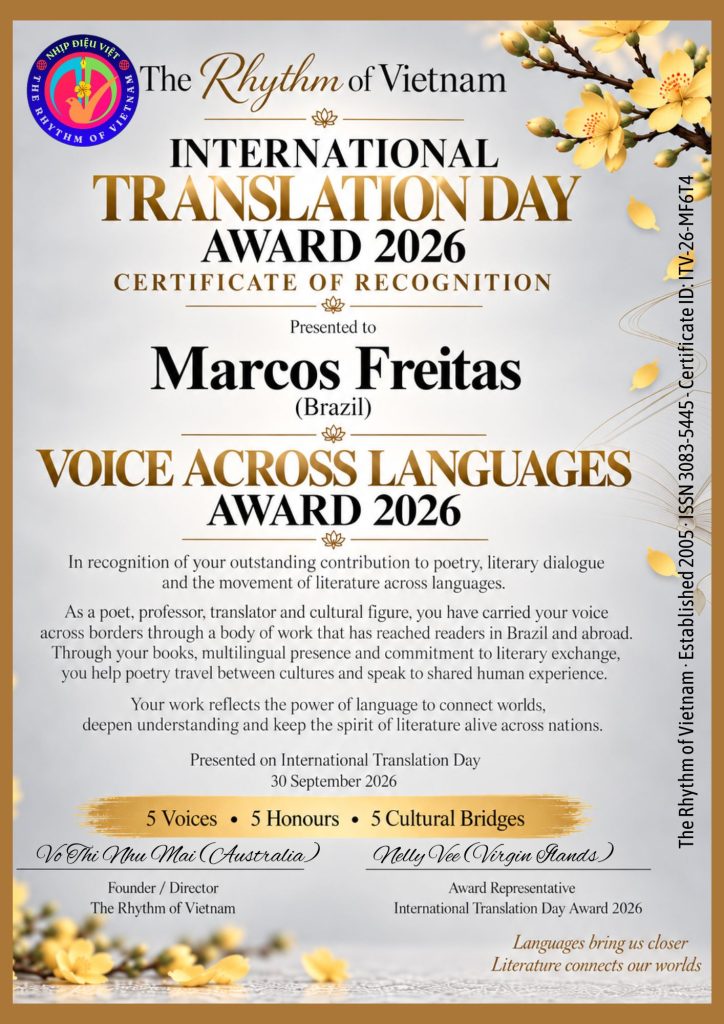
Marcos Freitas was born in Teresina, the capital of the Brazilian state of Piauí, and has lived in Brasília since 2001. He is a poet, university professor, engineer, and public-sector professional whose career combines literary work with technical and environmental expertise.
Freitas earned a bachelor’s degree in Civil Engineering in 1985, a Master of Science in Water Resources in 1991, an MBA in Public Management in 2009, and a Dipl.-Ing. qualification from the University of Hannover in Germany in 1995.
His books include A vida sente a si mesma, A terceira margem sem rio, Moro do lado de dentro, and Staub und Schotter, among other works.
He is affiliated with the National Association of Writers (ANE), the Brazilian Union of Writers (UBE), and Academia de Letras do Brasil (ALB). He also serves as co-chair of the BRICS Literature Network.
Freitas is both a poet and an advocate for environmentally responsible approaches to the climate emergency through his professional work in water resources. His poetry draws human meaning from lived experience and frequently engages questions of solitude, persistence, pain, language, and the writer’s relationship with the blank page.
KVI Profile Highlight
His work brings poetry, environmental responsibility, and lived human experience into the same creative field.
Why These Five Translators Matter
The five recipients do not represent one language pair, one country, or one literary tradition. Their work moves among English, Spanish, French, Arabic, Bangla, Hindi, and other cultural and literary environments.
That diversity matters because serious translation requires more than vocabulary. A translator must negotiate tone, rhythm, history, symbolism, cultural context, idiom, memory, and the intentions of the original writer. When done responsibly, translation expands access without pretending that cultures are interchangeable.
The recipients also demonstrate different models of translation work: Indigenous literary exchange, English-to-French poetry, South Asian multilingual translation, Arabic access to global and Silk Road literature, and international poetic and cultural engagement from Brazil.
About Võ Thị Như Mai
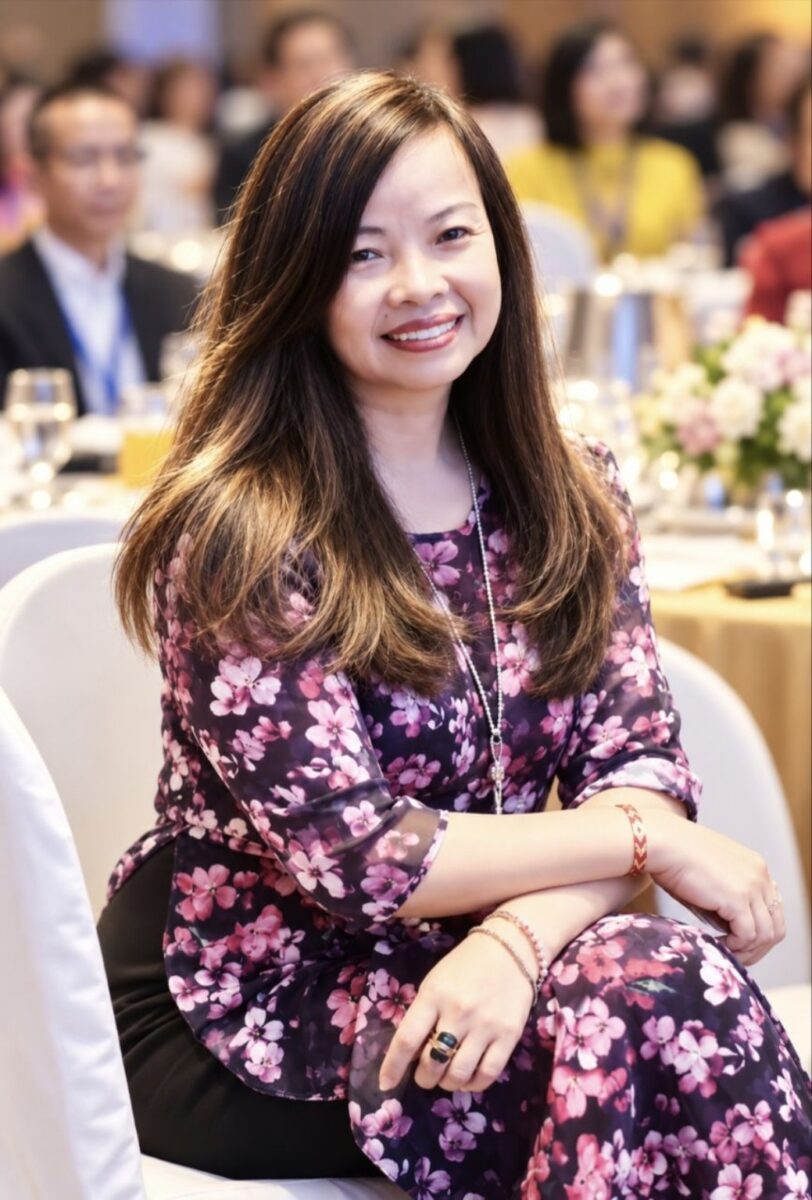
Võ Thị Như Mai is a Vietnamese-Australian poet, translator, educator, editor, and literary curator based in Western Australia. She is the founder of The Rhythm of Vietnam, a literary platform dedicated to Vietnamese and international writers, translation, and cross-cultural exchange.
Her work spans poetry, bilingual literature, education, anthology development, and international literary collaboration. She has more than two decades of teaching experience in Western Australia and is also active as a writer and journalist with Multicultural Press. Within KVI Network, she has contributed literary and editorial work to Krafty Page ChronicleS and has helped strengthen its international creative reach.
Explore Mai’s work:
KVI Network and the Recognition
For KVI Network, this recognition aligns naturally with our broader work in publishing, literature, cultural storytelling, and international creative exchange. The strongest cultural work does not erase difference; it creates room for people to understand one another more clearly through it.
KVI Network is honored to help recognize this year’s recipients alongside The Rhythm of Vietnam. We congratulate Juan Garrido Salgado, Alexandra Cretté, Nandita Samanta, Ashraf Aboul-Yazid, and Marcos Freitas on their 2026 International Translation Day recognition.
Official Reference
Read the Official Announcement
Explore additional KVI Network coverage through Awards & Recognition, Articles, and Culture & Heritage.