 thesilkroadtoday
In a remarkable episode titled “The Journey of Epics: From Literature to Cinema,” Nile Culture Channel opened a fascinating window onto one of humanity’s most enduring and influential forms of creativity. Broadcast on June 1, 2026, the program Kawalees hosted poet, writer, traveler, and scholar Dr. Ashraf Aboul-Yazid, Editor-in-Chief of the Silk Road Creativity Series, for an enriching discussion that bridged literature, history, philosophy, and cinema. The episode explored how the world’s great epics traveled from oral traditions and poetic texts to the silver screen, becoming part of humanity’s visual memory.
Produced by by Susan Abbas Al-Baroudi and Fatma Al-Zahraa Hassan, edited by Hanan Fikry and Riham Ragab, and directed by Metwally Ismail Al-Deeb, the episode offered viewers an engaging intellectual journey across civilizations. It emphasized that epics, regardless of their language or era, ultimately tell the story of humanity itself—the eternal search for meaning, identity, and immortality.
The discussion began with a fundamental question: What is an epic, and how has it survived for thousands of years without losing its appeal? Dr. Aboul-Yazid explained that an epic is far more than a lengthy tale of heroism. It is a symbolic record of a people’s collective experience, where history, mythology, and cultural memory converge. He noted that the Arabic word malhama (epic) derives from a root associated with close combat and fierce battles, while its Latin origins refer to narratives sung in poetic form. The epic hero, he explained, acts not merely for personal glory but carries the destiny of a community or nation, undertaking a journey filled with trials and existential questions.
The conversation highlighted the universal themes shared by epics across cultures: the search for identity and immortality, the struggle between good and evil, the confrontation with fate, and the pursuit of freedom and meaning. According to Dr. Aboul-Yazid, these timeless concerns have enabled epics to transcend geographical and historical boundaries while making them an ideal source for cinematic adaptation.
As the art of image and motion, cinema has found in epics an inexhaustible reservoir of dramatic material. Grand battles, perilous journeys, extraordinary characters, and complex moral conflicts provide filmmakers with opportunities to create spectacular works that combine visual splendor with intellectual depth.
One of the program’s key segments focused on Homer’s Iliad, which reached modern audiences through the film Troy. Dr. Aboul-Yazid observed that the film successfully translated the epic world into a contemporary cinematic language while centering on figures such as Achilles and Hector. At the same time, it sparked debate about whether it emphasized individual heroism or the broader tragedy of war. The discussion also explored the Odyssey, the epic of return and homecoming, whose themes of adventure, mythology, loyalty, and longing for home continue to inspire filmmakers today.
The journey then moved eastward to India’s monumental epics, the Mahabharata and the Ramayana. Dr. Aboul-Yazid described the Mahabharata as one of humanity’s richest and most complex literary works, weaving together war, philosophy, religion, and politics. The Ramayana, meanwhile, remains celebrated for its enduring values of devotion, duty, and sacrifice—qualities that have allowed it to resonate far beyond India’s cultural borders.
Another major stop was the Epic of Gilgamesh, the oldest known epic in human history. The discussion centered on the timeless question at its heart: Can humanity overcome death? Dr. Aboul-Yazid noted that Gilgamesh’s quest for immortality still speaks directly to modern anxieties and aspirations. The episode also examined the animated film Gilgamesh — The Oldest Story Ever Told as a contemporary effort to bring this ancient masterpiece to new audiences.
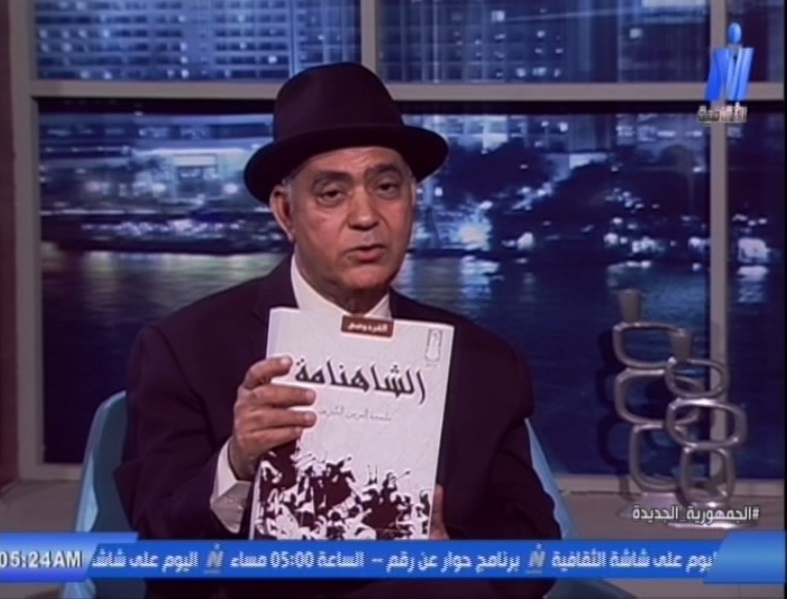 The Persian masterpiece Shahnameh, composed by Ferdowsi, also received significant attention, particularly through the tragic tale of Rustam and Sohrab, one of the most moving stories in world literature. Dr. Aboul-Yazid pointed out that the Shahnameh became accessible to Arab readers through an important edition published by Dar Suad Al-Sabah in Kuwait, featuring an extensive introduction of more than one hundred pages by the distinguished scholar and first Secretary-General of the Arab League, Abdul Wahab Azzam, who played a pioneering role in introducing Persian literature to Arab audiences.
The episode then turned to Northern European and Germanic traditions through the film Beowulf, which reimagined the ancient English epic using modern digital technology. The discussion compared the image of the hero in these traditions with those of Greek and Eastern epics, where the confrontation with evil often takes on darker and more complex dimensions.
The program also shed light on African epics, which remain underrepresented in global cinema despite their rich dramatic and visual potential.
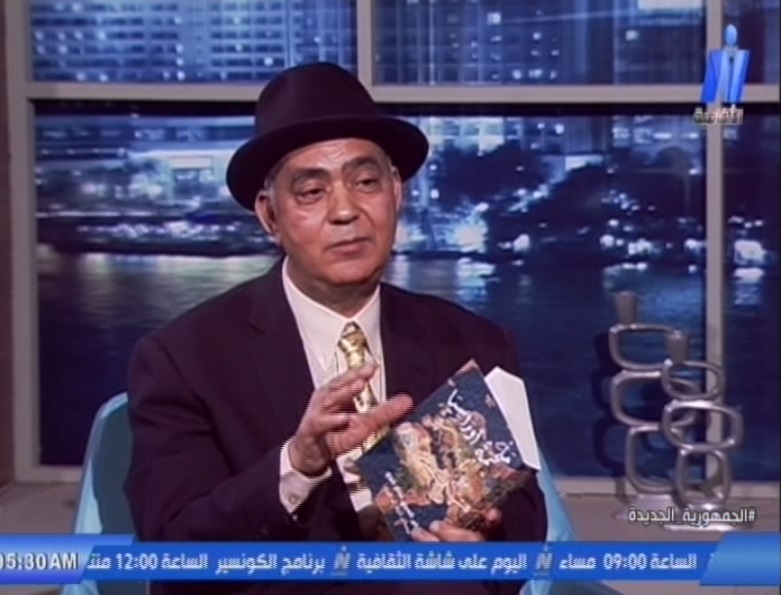
The episode concluded with a discussion of Eurasia, the epic poem by the iconic Chinese poet Cao Shui, presented as a modern attempt to transcend national boundaries and create a universal epic connecting the civilizations of the Silk Road. Dr. Aboul-Yazid, who translated the work into Arabic, explained that Eurasia represents a new stage in the evolution of epic poetry. It comes after the early epics that intertwined human destinies with divine powers and after the didactic epics of moral and philosophical instruction, emerging instead as an epic of the free-verse era capable of embracing history, geography, and diverse cultures within a single poetic vision.
The program also featured a recorded message from Cao Shui, who spoke about his lifelong dream of traveling from China to Egypt along the Silk Road, passing through India, Persia, Babylon, Canaan, and Greece. He explained that Eurasia was born from this vision of uniting the great civilizations of humanity within a single epic narrative. Expressing his delight at the Arabic translation by Dr. Ashraf Aboul-Yazid, Cao noted that the work has already been translated into ten languages. He described his broader literary project as an effort to unite Eastern and Western civilizations, ancient and modern cultures, and sacred and secular traditions in the creation of what he calls “Great Poetry.”
This is his full word:
“Epic of Eurasia: An Epic from Chinese to Egyptian Arabic, by Cao Shui (China)
Since my youth, I have cherished a dream: to ride a horse from China, travel along the Silk Road, and reach Egypt. Along the way, we would pass through India, Persia, Babylon, Canaan and Greece, experiencing the splendor of these civilizations. Today, the great Egyptian poet Ashraf Aboul Yazid has turned this dream into reality. Later, I wrote *Epic of Eurasia* precisely based on this vision, for the Eurasian continent was once the cradle of humanity’s major civilizations and remains the homeland of all humankind.
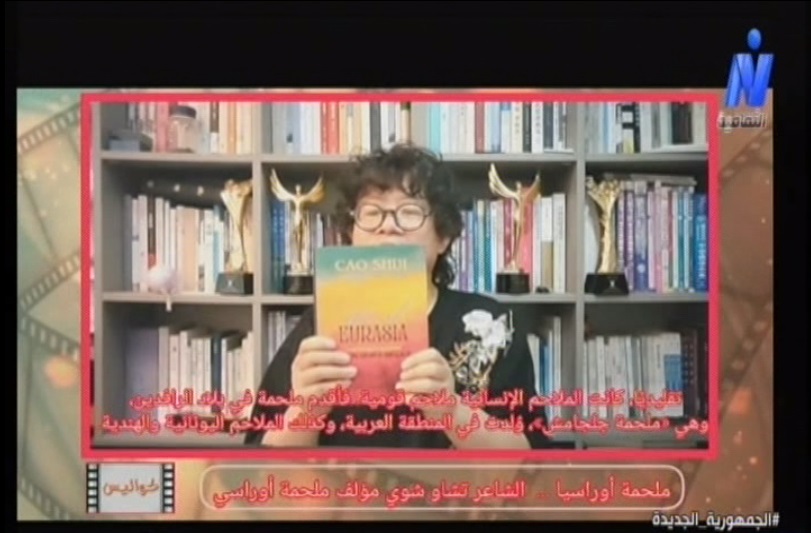
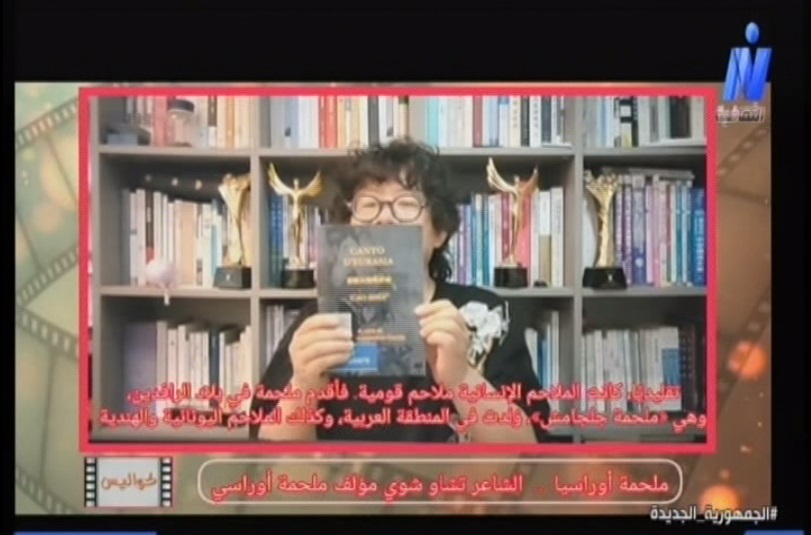
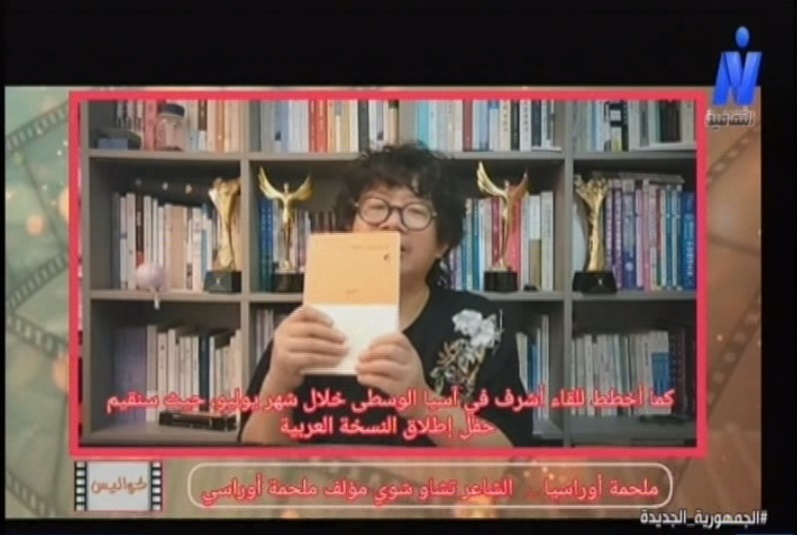
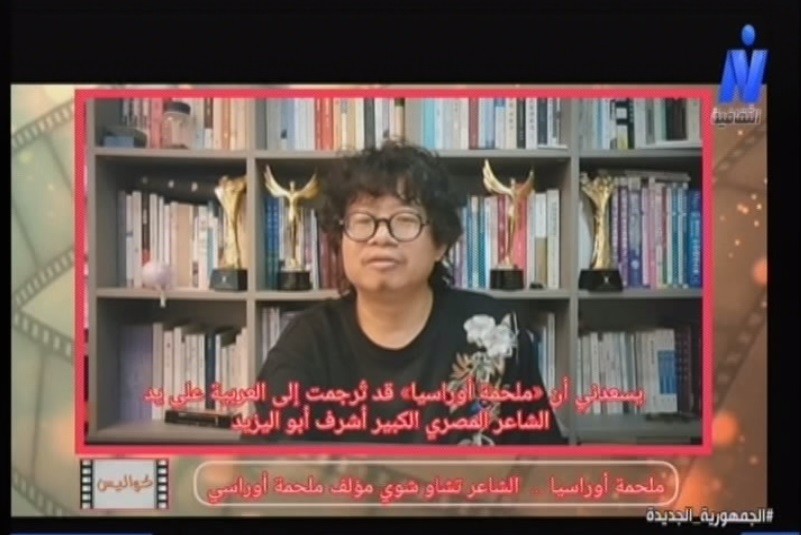
I am delighted that my *Epic of Eurasia* has been translated into Arabic by the great Egyptian poet Ashraf Aboul Yazid. Arabic is an ancient language, descended from the ancient Akkadian language and the inheritor of the language used in the *Epic of Gilgamesh*. It is the official language of 22 Arab countries. Since its publication, this book has been translated into ten languages. This is the Chinese edition, this is the Italian edition, and this is the English edition. I also plan to meet Ashraf in Central Asia in July, where we will hold the launch ceremony for the Arabic edition.
Traditionally, human epics have been national epics. The oldest Mesopotamian epic, the *Epic of Gilgamesh*, was born in the Arab region, as were Greek epics and Indian epics. These traditional epics are all national epics. In writing *Epic of Eurasia*, I hope to integrate all ancient civilizations—starting from Babylon, westward to Canaan, Egypt and Greece, and eastward to Persia, India and China—to create an epic for all humanity. This is also the pursuit of the Great Poetry Movement I founded. We hope to integrate Eastern and Western civilizations, ancient and modern civilizations, and sacred and secular civilizations to create great poetry.
Humanity comes from the same place and will inevitably reach the same destination. According to Spencer Wells’ *The Journey of Man: A Genetic Odyssey*, all modern humans descend from a single ancestor 100,000 years ago. We walked out of Africa and dispersed in all directions from Mesopotamia, forming the present-day yellow, white and black races. Yet we remain the same species, sharing 99.99% of our genes.
Today, through *Epic of Eurasia*, I want to make a loud appeal: it is time for humanity to unite. The future of humanity will surely be one language, one nation, one country. It may take five hundred years, but I firmly believe: we come from the same place and will surely arrive at the same destination.”
Thus, the episode’s journey—from Gilgamesh to Homer, from Ferdowsi to Cao Shui—demonstrated that epics, despite the diversity of the cultures and eras that produced them, remain a grand mirror reflecting humanity’s enduring dreams, fears, and eternal questions about life, identity, and immortality.