

thesilkroadtoday
- أدب , شخصيات
- نوفمبر 13, 2026
- 14 views
The Pokhrelian Stanzas: A Manifesto for Compact Syllabic Verse
Santosh Kumar Pokharel Multilingual Poet and Writer Inventor of the Pokhrelian Stanzas Bhaktapur, Nepal pokharel.santosh@gmail.com — Abstract This manifesto describes the Pokhrelian Stanzas, also circulated as #pokhreliknots, a stanzaic form I developed in Nepal between 2024 and 2026. To my knowledge, the haiku has brevity, seasonal reference, and the cutting word, but it does not have frame rhyme, a marked apex, or a symmetrical syllabic contour. I brought this poetry style for poets across cultures, so that the short poem might carry closure as well as compression, a summit as well as a silence, and a contour the eye can see as well as a shape the ear can hear. The form rests on the Law of Return: the first and last lines of every stanza rhyme or near-rhyme. This law is combined with a symmetrical syllable pattern that expands to a central apex and contracts again. Two families have emerged: the Morphosemantic Triangulum, in which the apex is a single line, and the Morphosemantic Trapezium, in which the apex is doubled. A third, polysyllabic variant permits extended lyric and argumentative composition. Beyond the frame rhyme the form admits an optional second order of sound: intermittent end-rhyme among the intermediate lines, which I have used in several poems to smooth the stanza’s flow and bind its interior. The stanza’s syllabic contour is not decorative but morphosemantic: the shape of the stanza carries the shape of its meaning. The form is written without punctuation, and this is its beauty: the unpunctuated stanza compels the reader to think over each stanza before jumping ahead. It is now being written in English, Nepali, Hindi, and Bangla. This manifesto sets out what the form offers that the haiku, free verse, blank verse, and the classical sonnet do not. It is written from inside the form. It is a poet’s account of a structure he made, offered to other poets to use or to refuse. The Knot is tied; the poem is released. Keywords: Pokhrelian Stanzas; #pokhreliknots; syllabic verse; frame rhyme; near-rhyme; intermittent rhyme; morphosemantics; stanzaic form; comparative poetics; Nepali poetry; manifesto — Introduction:A Form That Obliges For most of the last century the short poem in English has been written in free verse. The line has grown longer or shorter at the poet’s pleasure; rhyme has been used when it suited and dropped when it did not; and form has been a matter of individual invention rather than inherited discipline. The haiku, the most widely practiced short form in the world, is governed principally by brevity and by seasonal reference. The sonnet, the most durable fourteen-line form, is still governed by line count, but its rhyme scheme has been relaxed almost everywhere to the point of abandonment. I have no quarrel with any of these. I have written in them myself. But I came to feel, after several thousand poems, that the short poem had lost something it once had: a sense that the poem’s shape was not the poet’s private decision but a structure the poem was written into. I wanted a form that would oblige me. Not a form that would confine me, but one that would make demands I could not evade by writing more loosely. The Pokhrelian Stanzas are the result. I began with a three-line stanza in March 2024 and called it the Trentet. I extended it to five lines, then seven, then fourteen, then twenty, then twenty-five, and the form took the name #pokhreliknots and later the Pokhrelian Stanzas. It has since been taught in workshops in Nepal, presented at Tribhuvan University and at Janata Multiple Campus in Udayapur, and taken up by poets in Nepal, India, the Philippines, and elsewhere. This manifesto describes what the form is, how its shape carries meaning, and what it offers the contemporary poet. It is written from inside the form. I invented it, I have written in it for two years, and my judgement of it is not neutral. I say this at the outset because a reader should know what kind of document this is. It is not a survey and not a reception study. It is a poet’s manifesto, offered to the poets across the continents to try it in their poetry crafting. — TheManifesto: Ten Theses Rhymeis architecture. A rhyme that can be dropped is ornament; a rhyme that cannot be dropped is structure. The Pokhrelian Stanza is built on the second kind. TheLaw of Return. In every stanza, the first and last lines rhyme or near-rhyme. A stanza in which they do not is not a Pokhrelian Stanza, whatever else it may be. III. The shape carries the meaning. The stanza rises to an apex and falls again. The ascent gathers; the apex holds; the descent releases; the frame returns. This is the morphosemantic principle. Theapex may be single or doubled. In the Triangulum the apex is one line; in the Trapezium it is two. The single apex states; the doubled apex reverberates. Thecount is exact and visible. Every line has a specified syllable count, and the counts rise and fall symmetrically. The shape is visible on the page before a single word is read. Theinterior is the poet’s. Intermittent rhyme among the middle lines is licensed, not required. It sets the stanza’s temperature; the frame guarantees its closure. VII. The form scales. The same law governs three lines and twenty-five. The poet chooses the span; the form guarantees the shape. VIII. The form travels. It is defined by counts and rhymes, not by metre or by any one language’s prosody. It is now being written in English, Nepali, Hindi, and Bangla, and presumably in other languages. Thepoet accepts the obligation. The form makes demands that cannot be evaded by writing loosely. The obligation, once accepted, generates the poem. Theform is offered, not imposed. Take it. Tie the Knot. Release the poem. — TheoreticalFraming …
- نوفمبر 13, 2026
- 0 views


الثقافة جسر بين الشعوب: قمة عمّان تناقش الذاكرة التاريخية والحوار الحضاري
- نوفمبر 13, 2026
- 5 views

For an African Literary Sovereignty Open to the World
- نوفمبر 13, 2026
- 11 views
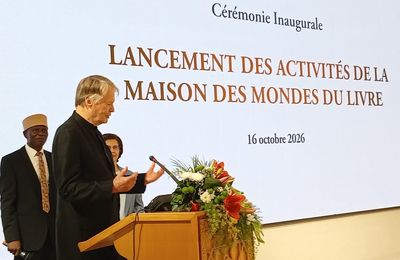
الخيالات الأفريقية والعالمية تحتفي بها الرباط
- نوفمبر 13, 2026
- 9 views
The Pokhrelian Stanzas: A Manifesto for Compact Syllabic Verse
- نوفمبر 13, 2026
- 14 views